Category Archives: Places

Tenting for termites

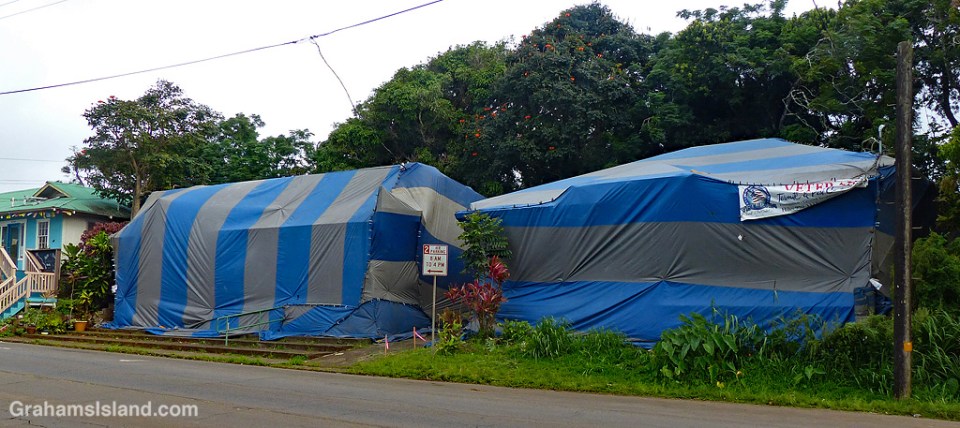
Tented for termites

No, it’s not the circus come to town. These tents are for a more macabre purpose, the termination of termites.

As in most warm climates, termites are a problem here. Houses, especially older ones, are easily colonized. Without treatment, the occupying termites will consume wood from the inside, leaving a thin membrane as protection. Infested wood might look fine, but a gentle push on the surface will go right through two or three layers of paint to the termites’ cavern inside.

Besides leaning against a wall and going right through, a prime indicator of termites is small mounds of little round pellets below a pinprick hole in a wall or piece of furniture. These are termite fecal pellets, which the worker termites clear out of the nest from time to time.

Another indicator of the presence of termites is to turn a light on and find a horde of them flying around the room. Around here, May is the prime time for this activity. These flying termites are fertile males and females, leaving the nest they grew up in to find a place of their own and start a new colony.

As unpleasant as it is to find a room full of flying termites, it’s even worse to wake up and see countertops littered with discarded wings, a sure sign that these fertile termites have moved in to a new spot.

So tenting for termites is common practice here. The structure is covered with nylon sheeting until it is completely sealed and then a fumigant is pumped in. The tent usually remains on overnight. After the tent is removed, the house has to sit empty a while for the gas to dissipate. It’s not wise to go back in too early or one could find oneself joining the termites. Typically it can be two or three days before a home can be reoccupied.

Tenting for termites is effective but it has downsides. It works for drywood termites, but not subterranean termites since they live outside the house and just dine inside. There are also environmental concerns about the process. And while fumigation works, there’s no guarantee that a new colony of termites won’t move in just as soon as the gas has cleared.
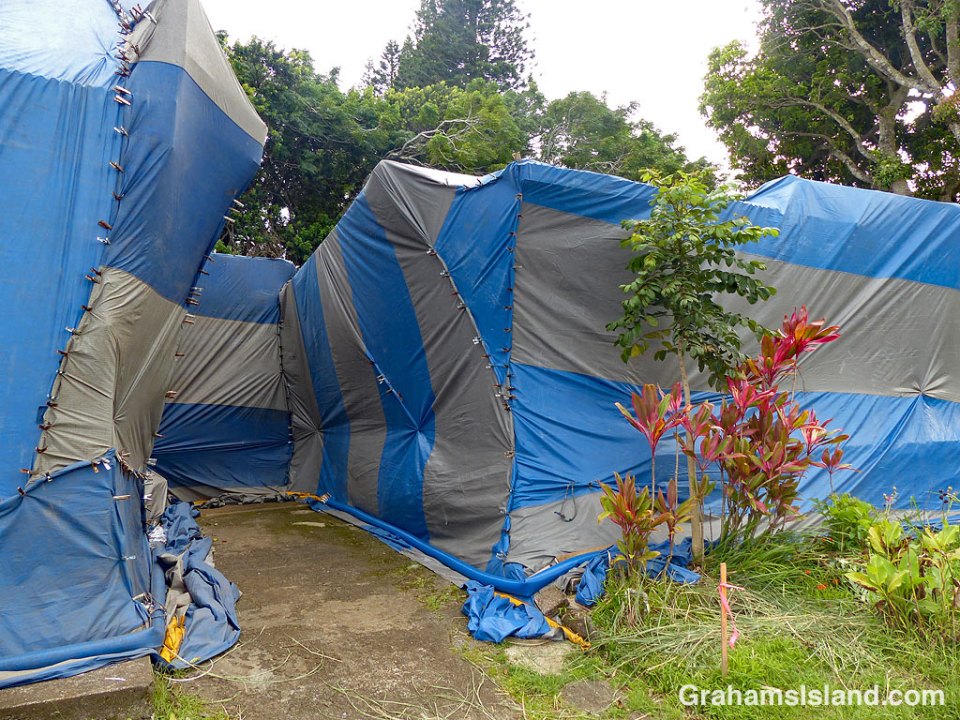
Tenting for termites

Fish farm

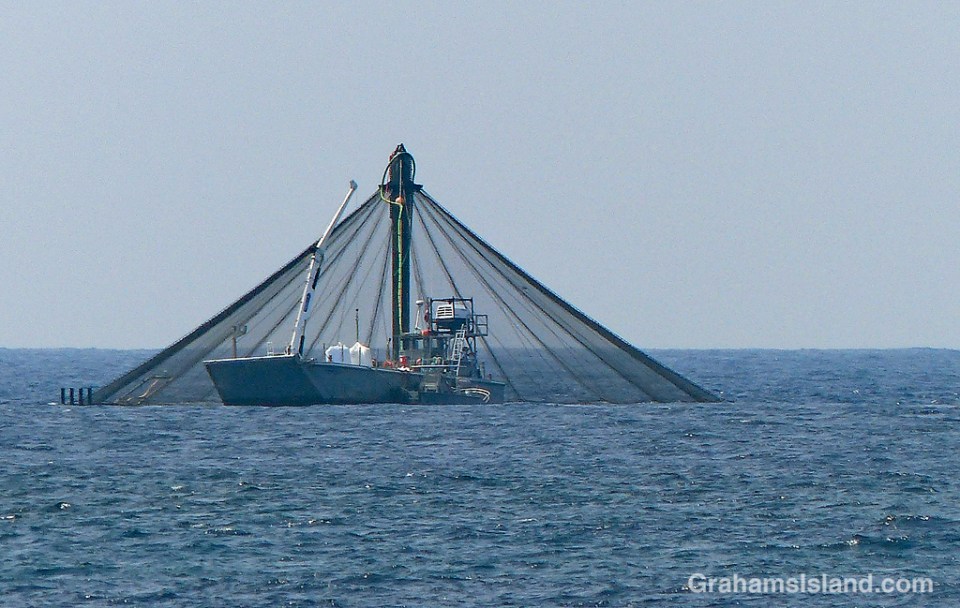
Fish farm net pen and boat

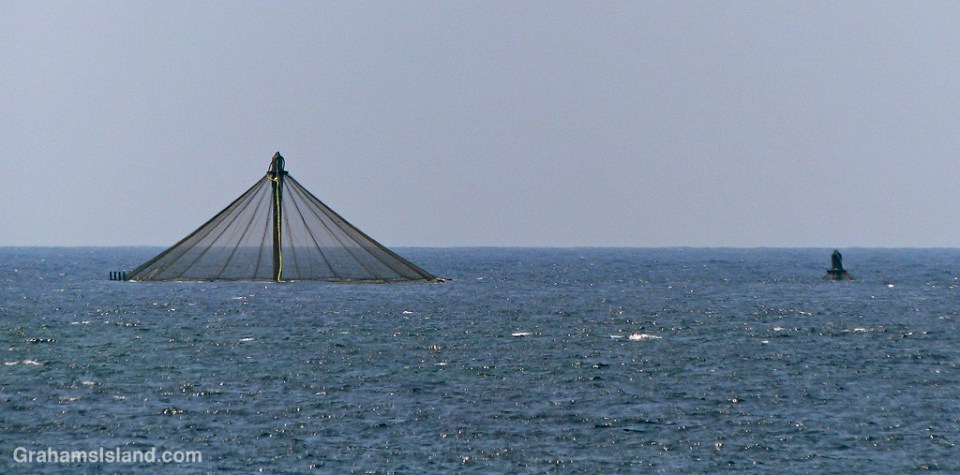
Not far off the Kona coast, near the airport, one or more of these nets can often be seen. They’re the submersible net pens of a fish farm run by Blue Ocean Mariculture. The farm raises Almaco jack which it markets under the name Hawaiian Kanpachi.

In the wild, the fish is prone to ciguatera, a toxin that can cause diarrhea, vomiting, numbness, and other unpleasant symptoms. This is the reason almaco jacks aren’t fished commercially. But the farmed fish are free of this problem. I have mixed feelings about farmed fish, but this farm seems to be well regarded and is approved by Monterey Bay Aquarium’s Seafood Watch.

Part of my ambivalence may be down to the fact that, last year, one of the few resident monk seals living around the island became trapped in a pen and drowned. I’ve since heard that when work is being done on a pen, it should be raised so part is above the surface. That way, if something swims into a pen and can’t get out again, it can at least surface inside the pens to breathe. Whether that happened in this case, I can’t say. The official word is that mariculture projects in Hawaii are under review by the Army Corps of Engineers and NOAA.

Fish farm net pens

Wind turbines crank out the power

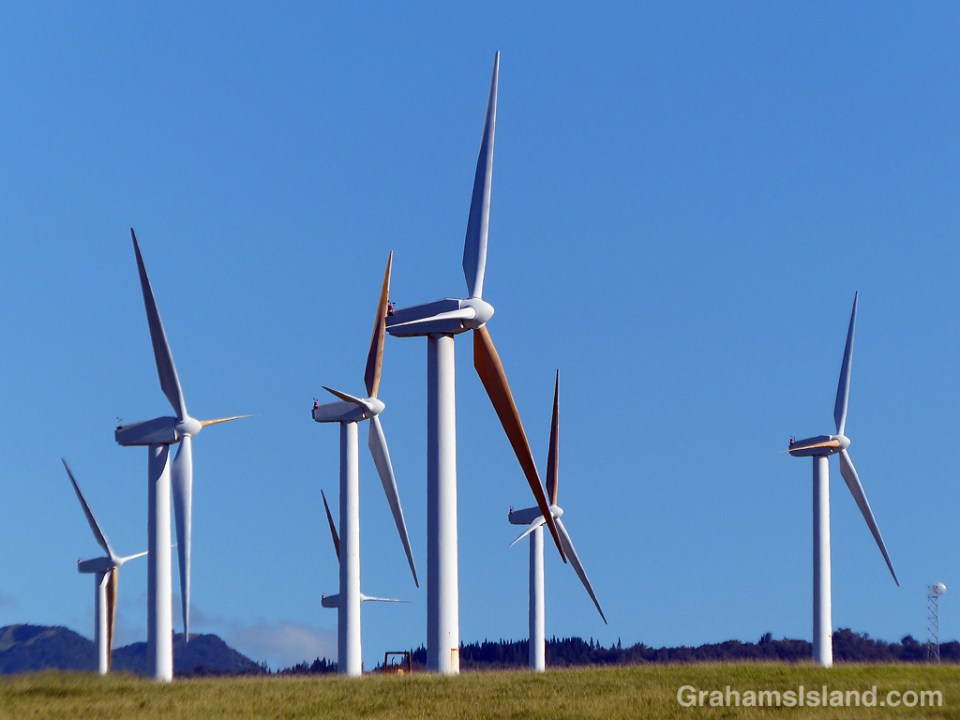
Wind turbines Hawi and Mauna Kea

This week’s Sunday Stills challenge is ‘Drunk with .…’ I thought about a photo of my liquor cabinet, but settled instead for ‘Drunk with Power,’ a reasonable choice in these turbulent times.

Hawi Wind Farm began operations in 2006 and has 16 turbines churning out 10.56 MW. This power is supplied to Hawaii Electric Light Company, which runs the power grid on the island.

My interest in the wind farm is mostly visual. I like the patterns that the turbines make, and every once in a while the telescopes of Mauna Kea can be seen in the distance.

See more Sunday Stills responses here.

Wind turbines Hawi

Abstracts: Rainbow Falls banyans

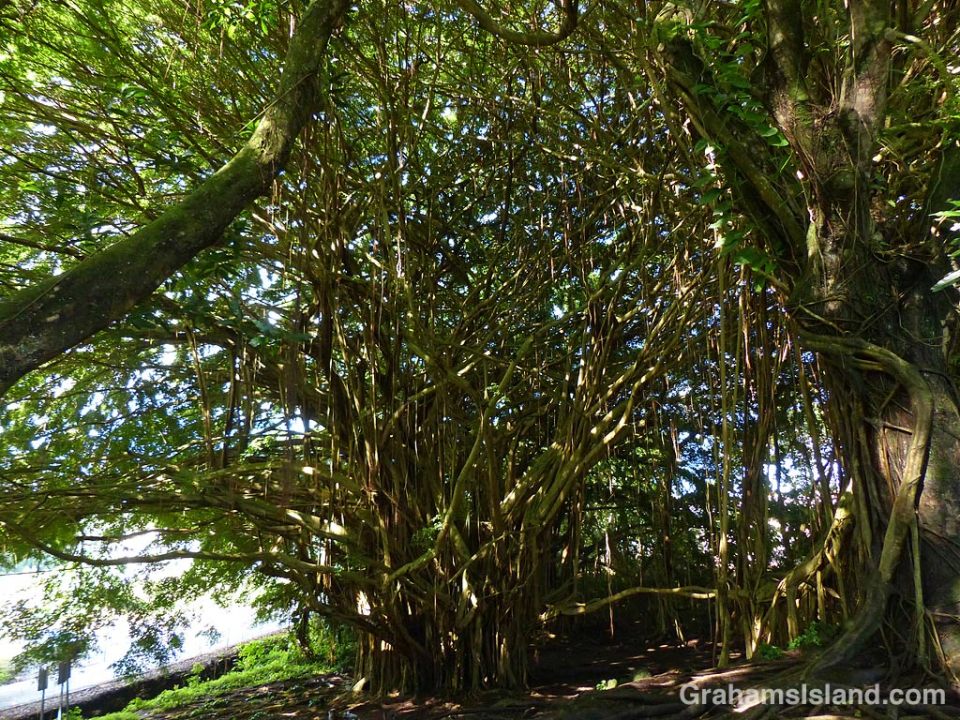
Abstracts-Rainbow Falls Banyans

Abstracts-Rainbow Falls BanyanThe main attraction of Wailuku River State Park, in Hilo, is Rainbow Falls. But at the top of the hill are these huge banyan trees.
Banyans are not just a huge sprawl of branches, but a sprawl of roots, too. As epiphytes they begin life growing on other trees, from seeds dispersed there by birds. Over time, they send roots down to the ground, known as prop roots, which help support the mass of branches.

Banyan trees are also known as strangler figs because their roots and branches will ultimately overwhelm the host tree and kill it. Eventually, the dead host will decay and leave a hollow center to the banyan tree that’s left.

By continuing to send down prop roots, banyans grow out as well as up. Very old trees can cover a huge area. For example, the Great Banyan Tree in Kolkata, India is more than 250 years old. Its covers around four acres and has more than 3,500 prop roots. Here in Hawaii, the largest banyan grows in Lahaina on Maui. Planted in 1873, it now has 16 main trunks and covers two thirds of an acre.

The Rainbow Falls trees aren’t that large, but they’re coming along nicely.

International takeoff

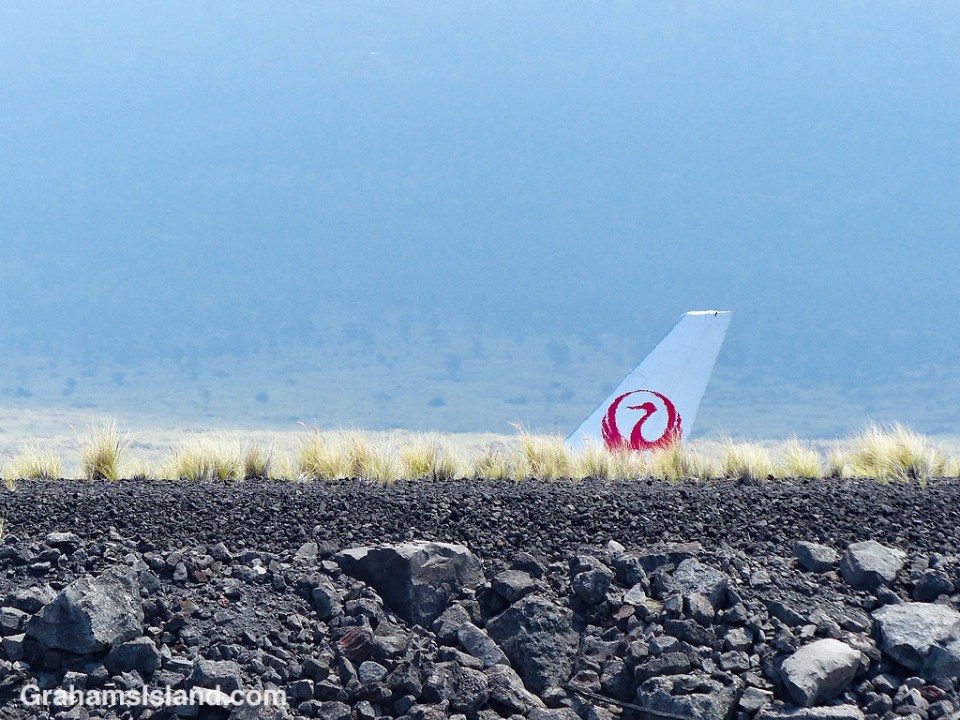
Japan Airlines plane tail

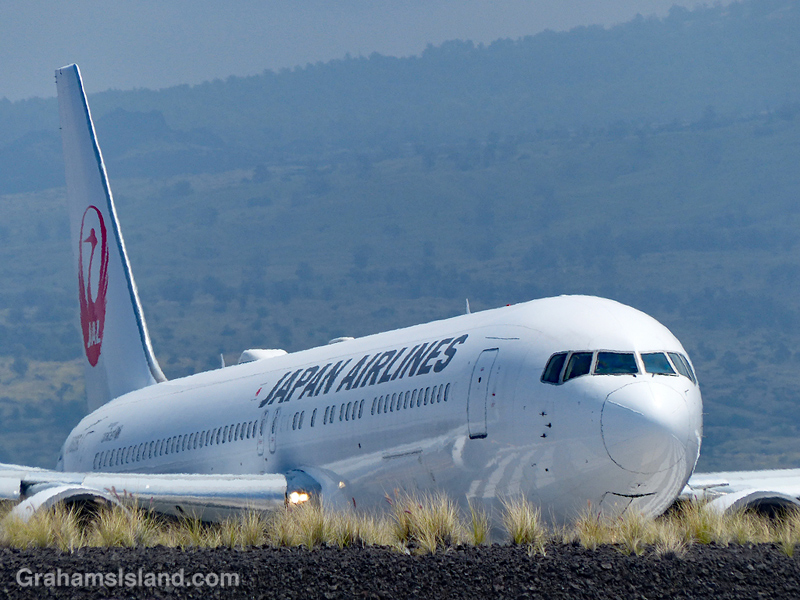
Japan Airlines planeKona airport is officially called the Ellison Onizuka Kona International Airport at Keahole.

Ellison Onizuka was an astronaut from Kealakekua, Hawaii, who died in the destruction of the Space Shuttle Challenger. Kona is the district and Keahole the place name for the actual location (Keahole Point) of the airport. And International? Well that’s largely due to the aircraft in these photos.

Japan Airlines (JAL) began flying to Kona from Tokyo in 1996, but suspended service in 2010. With no international flights coming in, the feds shut up shop, and that’s the way it stayed until the end of 2016. At that point, Hawaiian Airlines began service to Tokyo three times a week and a new Federal Inspection Service facility opened at the airport to accommodate the needs of the government. But the icing on the cake occurred in September of last year when JAL resumed daily flights to Kona. And in December of this year, Air Canada will begin seasonal nonstop flights from Vancouver. Très internationale!

These photos are of the outgoing JAL flight preparing to take off on the return journey to Japan. I took the top photo because it made me think of a shark cruising by.

Japan Airlines plane takeoff