
This bee was burrowing in to get what was on offer from a clover flower.

This bee was burrowing in to get what was on offer from a clover flower.

An Ashy Grey Lady Beetle climbs the buds of a Plumeria tree.
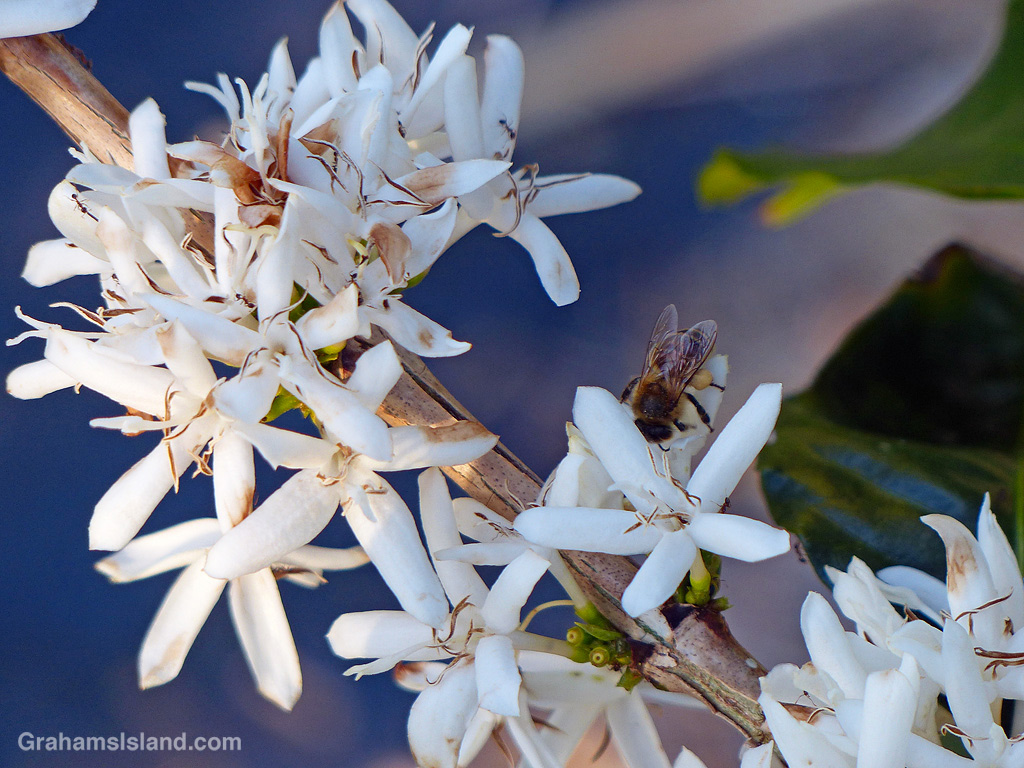
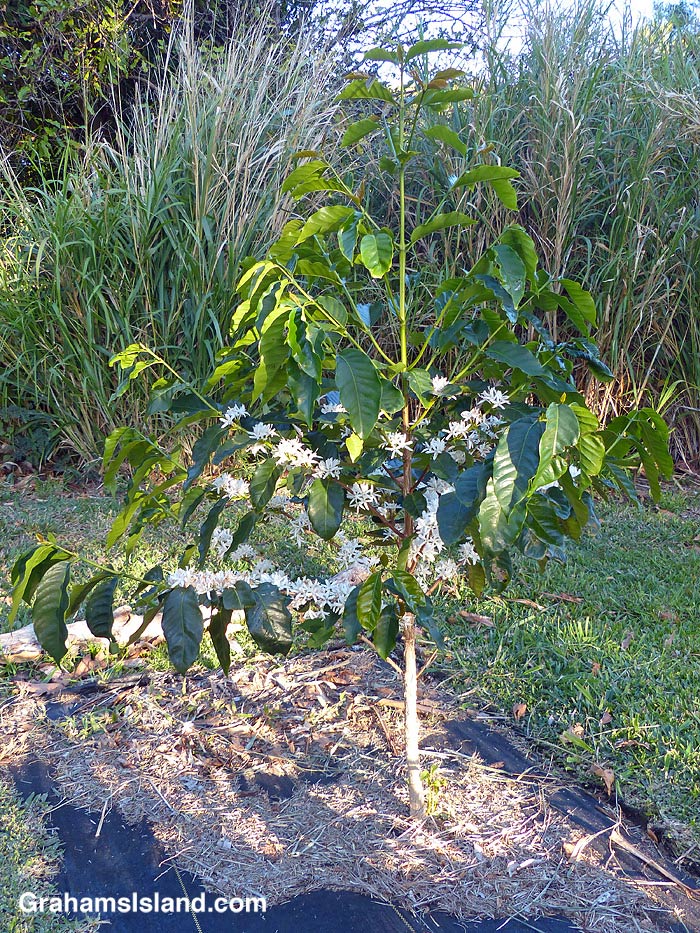
A couple of years ago, a hedge made up of several small coffee plants was planted along the edge of the old homestead. The plants have had mixed success thanks to uncooperative weather and a surfeit of chickens and pigs in the neighborhood.
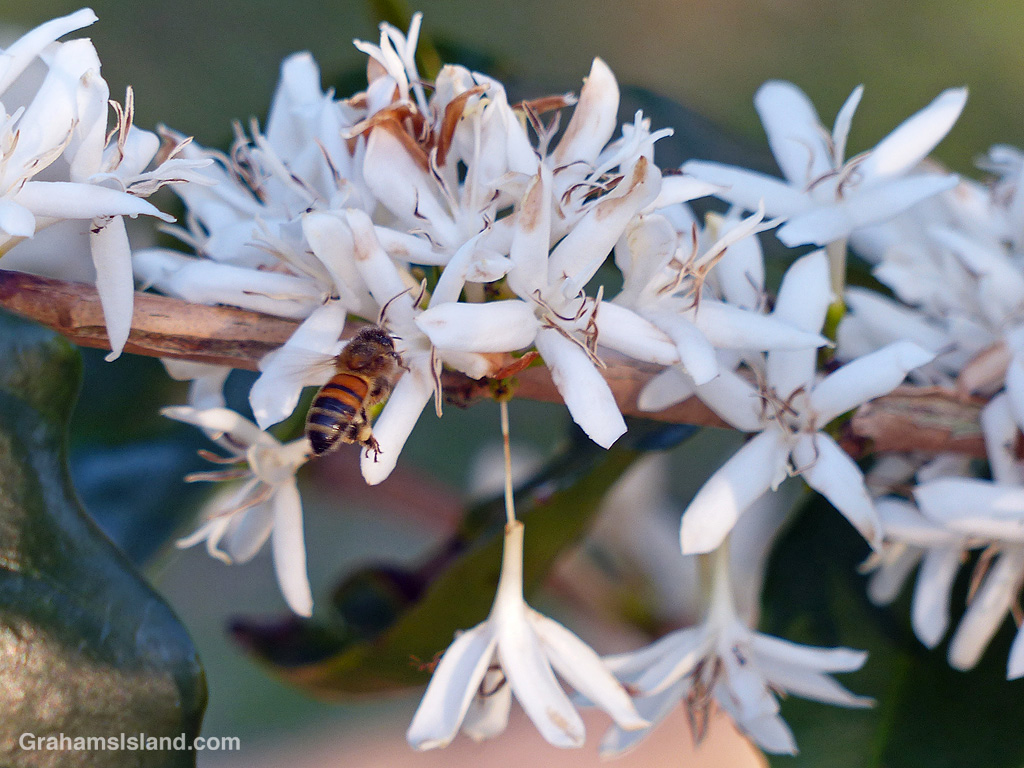
However, several of the plants have thrived and this year, for the first time, produced blooms. When I noticed them, I immediately walked over and stuck my head down there to see if they had any scent. I didn’t notice much, but what I did notice was a loud buzzing noise and I realized that, scented or not, the bees were having a field day.
So I withdrew my head and took these photos. I’m glad I did because the flowers were short-lived and a couple of days later they were gone.
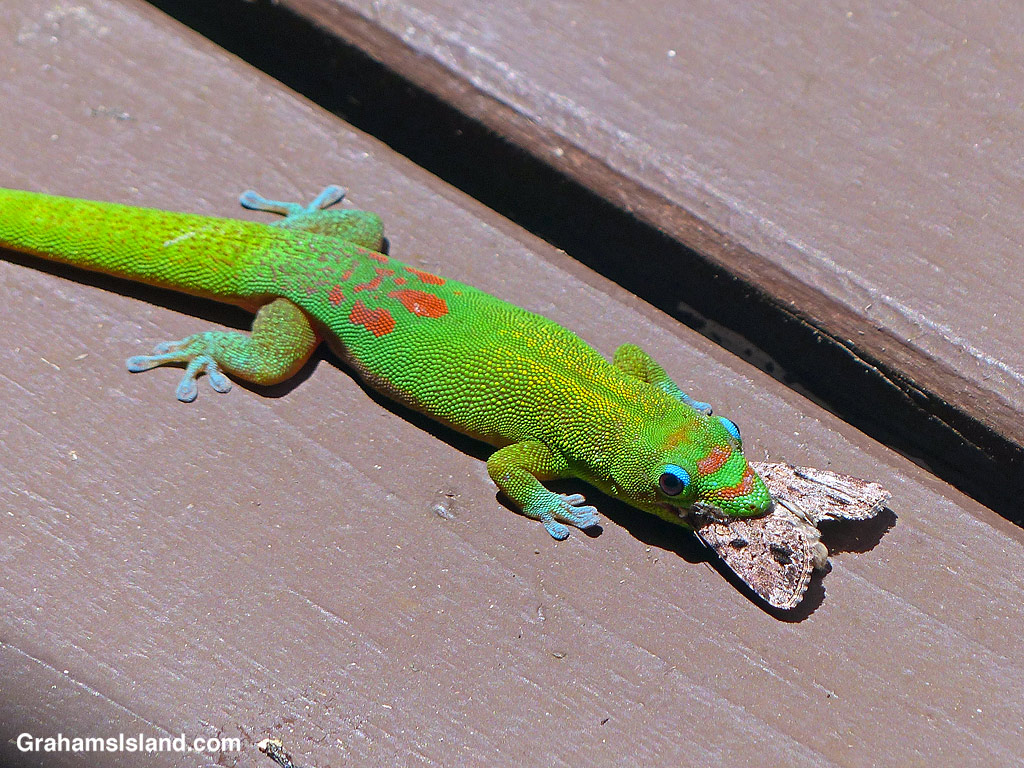
Most predators, on land and in the ocean, have a relatively poor success rate when it comes to snagging prey. Even when they’re successful, there’s no guarantee they’ll get to savor their prize.
I don’t know whether this Gold Dust Day Gecko was the one that caught this moth because, an instant after the capture, two or three other geckos swooped down to snatch it. There was a flurry of bodies and this one emerged from the scramble with the moth firmly stashed in its jaws. This look suggests it was guilty of robbery.

I spotted this shiny creature on the trunk of a mango tree, but wasn’t sure what it was. So I searched online using the striking details – iridescent green, red on legs, Hawaii – and the first result was a post on whatsthatbug.com. It was headlined, ‘Emerald Cockroach Wasp from Hawaii turns Roaches into Zombies!!!’ (link here). That got my attention! Within that posting was a link to a longer post with more details (here).
In brief, the female Emerald Cockroach Wasp (Ampulex compressa) stings a cockroach to temporarily disable its front legs. It does this to buy time to deliver a second sting to a precise spot in the cockroach’s brain that controls the roach’s escape reflex. The roach isn’t paralyzed, but it just stays where it is, that is until the wasp takes it by the antenna and leads its zombie prey back to her burrow. There she lays an egg on the roach, before walling up the burrow’s entrance. Back inside, the roach just waits while the egg hatches and the larva eats its way inside the roach and devours the roach’s organs. Four weeks later, a new wasp emerges from the roach and the burrow.
I was astonished to learn about this, in particular how, for the second sting, the wasp locates the exact spot in the roach’s brain using sensors on the stinger.
The source of the whatsthatbug.com description comes from Carl Zimmer who has a great article here. More information about this remarkable wasp can be found here, here, and here. And finally, a must see video of the wasp in action, including leading the cockroach to its lair, can be seen here.

For whatever reason, I don’t usually see much activity on bougainvillea flowers and I don’t see a lot of monarch butterflies. On this occasion though, this monarch was one of several insects feeding on a group of bougainvilleas.

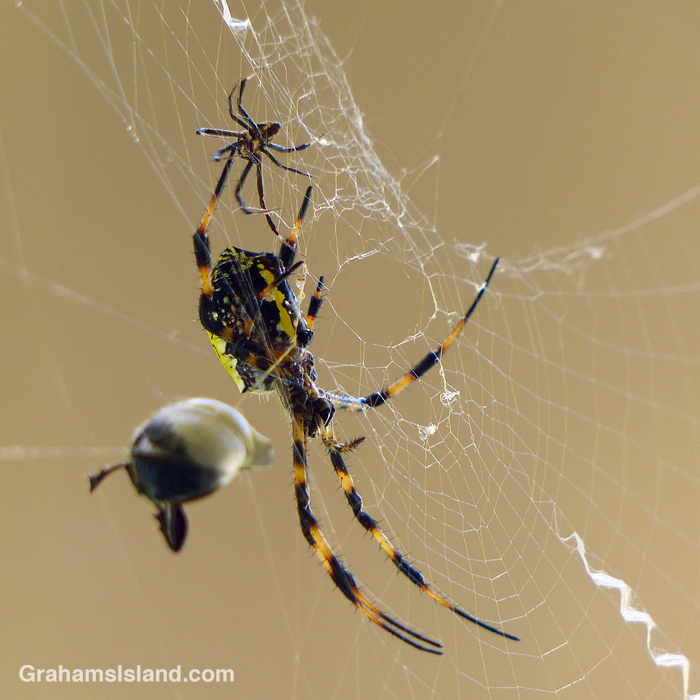
My house has been surrounded by spiders and their webs for most of the winter. One female Hawaiian Garden Spider has a web which angles across the living room window. I can follow the activities there from the comfort of the couch.
One morning, I raised the window blind and found this scene. The large, yellow-backed spider is the female. The much smaller drab, brown spider above her is the male, and when a male is seen on a female’s web there’s only one reason – he’s looking to mate with her. I’m not sure what the third character in this scene is. It might be a mango beetle, but it was securely trussed to the web.
What happened can be seen in the gallery. The male tried his mating moves, the female remained largely unmoved. Much of the time the male stayed on the relatively safe opposite side of the web to the female, but to mate he must venture to the other side. When he did, sometimes the female swung into action. Mostly, she seemed responsive, but one time the male disappeared in an instant. Then I saw him climbing back up the thread he’d dropped on. Something must have gone awry, but no harm done. Through all this activity, the beetle looked on, waving its little legs and antennae.


The presence of the beetle seemed to affect the delicate negotiations going on between the spiders. Sometimes, the male went over to the beetle and sort of prodded at it, but nothing more. In the early evening, the female lost patience. She straddled the beetle, shot out strands of threads, and rebound the beetle as she spun it with her legs. It turned like a rotisserie chicken in overdrive. I didn’t get photos of this as the light was fading.
Next morning, nothing much had changed. The female was still the central figure, the male still holding his position. The only difference is that the beetle had managed to push its legs and head through the engulfing threads and it was back to waving its little legs and antennae. Later that day, the male appeared to successfully mate with the female and escape alive. I last saw him wandering over to the next web along where he positioned himself carefully on the opposite side of the web spun by another large female.
The next day, there was still a female on the web but I think it was a different, smaller one than the one in these photos. The beetle was still there, still waving its little legs and antennae. That evening, the new female did the rotisserie chicken move on the beetle and retrussed it. Next morning, the beetle had freed its legs and head again and was waving its legs and antennae again.
The following day, only the new female spider could be seen!
Posted in response to this month’s Becky’s Squares challenge theme of ‘Odd.’ See more responses here.


I saw this female Sonoran Carpenter Bee (Xylocopa sonorina) in an Agave Attenuata and at first thought she was dead. But when I went out to look, she moved a bit, then burrowed deeper into the plants and disappeared from sight. I saw her three days in a row on the same plant and then she must have moved on. I’m not sure exactly what she was doing there. She didn’t appear to be collecting pollen but might have been doing so, albeit very slowly!
 Graham's Island