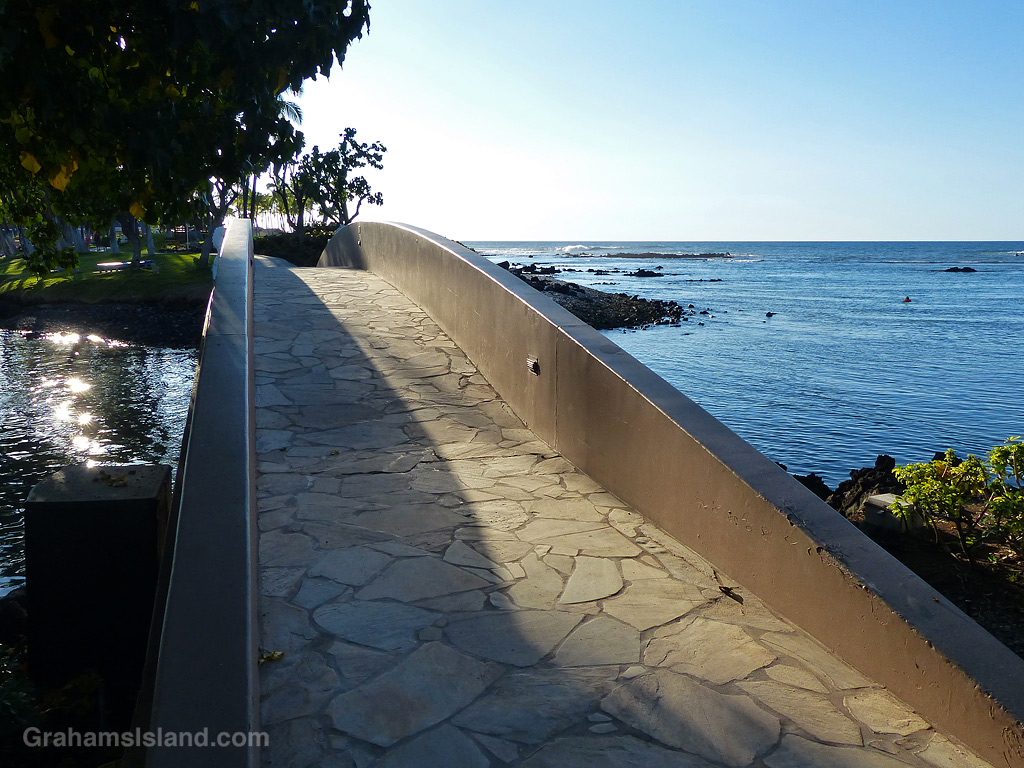
I like hiking and longer walks, but I’m equally happy staying closer to home and wandering around the yard here and at work. Here the sun peeks through the branches of an albizia tree.
Posted for Becky’s Squares theme of “Walking.” See more offerings here.
Many people collect plants, but some plants are collectors, too. On my last visit to Hawai’i Tropical Bioreserve & Garden it had recently rained. This bromeliad (above) and heliconia (below) had collected, not only water, but also an assortment of vegetation. There might even be a fish in there somewhere!
For more information about Hawai’i Tropical Bioreserve & Garden, go to htbg.com.
Posted for Becky’s Squares theme of “Walking” (See more responses here).
There’s an old saying that golf is a good walk spoiled. It’s often attributed to Mark Twain, though that’s probably not accurate. There’s an interesting investigation into the saying’s roots here.
The Mauna Kea Golf Course was designed by Robert Trent Jones Sr. in 1964 and its signature hole is the third. From the championship tee, which is where the top photo was taken, this doesn’t look like a hole that has much to do with walking. Swimming looks a more likely activity.
There’s a little marker in this tee box that shows the hole is 272 yards long, but other tees offer shorter options. Next to the tee box is a plaque noting the illustrious golfers who played at the course’s opening. And the bottom photo shows the green that a golfer would use in the unlikely event that their ball reaches it.
I’ve spoken to a couple of people who’ve hit balls from the championship tee, mostly for the pleasure of being able to say they did so. Both hit their ball into the ocean. I’d probably do the same, though there’s also a good chance my shot from there wouldn’t even reach the water!
Posted for Becky’s Squares theme of “Walking” (See more responses here).
Yesterday, I posted about Aphis nerii aphids descending on a Hawaiian Crown Flower (Calotropis gigantea). After they were gone the plant continued to do well for a day or two. Then holes started to appear in the leaves and arcs along the edges.
Closer examination revealed a couple of tiny Monarch Butterfly caterpillars munching their way around the leaves. The Crown Flower is a favorite host for these caterpillars, so this wasn’t a surprise. We were also keen to provide an area for the Monarchs to thrive in. So we let the caterpillars be and monitored the situation.
What happened, not surprisingly, is that the caterpillars grew quickly. As they did so, the leaves of the plant diminished accordingly. I was gone for my weekend, and when I returned, the caterpillars had more than doubled in size. The plant though looked like someone had gone at it with a machete. We wondered if the caterpillars would devour the whole thing before they pupated.
When I returned to work after another weekend, the caterpillars were gone. As the Crown Flower was food for the caterpillars, so it appeared, the caterpillars were food for the numerous birds in the area.
The plant will likely recover from its ravishing and, once it’s bigger, it might be better able to accommodate the attentions of these caterpillars and in turn provide more cover for them from the birds. Or not! I will monitor the situation.
Posted for Becky’s Squares theme of “Walking” (see more responses here).
I like hiking, as indicated by my last few posts, but I’m equally happy with a walk around the yard, at home or at work.
Recently, we planted a Hawaiian Crown Flower (Calotropis gigantea) at work. This was a stick with two small leaves on top. The two leaves dried up and the stem turned brown. It looked doomed, but then new leaves popped out near the bottom and the plant took off. New leaves every day, steady growth.
Then one day these showed up, little yellow drops, like tiny lemon candies. Close examination revealed legs and heads. Aphids! I think these are Aphis nerii, otherwise known as the Oleander or Milkweed aphid. These little sap suckers can do a lot of damage so we hosed them off, though I doubt the ladybug in the bottom photo was best pleased since aphids are a tasty meal for them.
Still, with the aphids gone, the plant continued to thrive until … (to be continued)
Posted for Becky’s Squares theme of “Walking” (See more responses here).
The Kilauea Iki Trail in Hawaii Volcanoes National Park is one of the most popular in the park, but I’ve never found it crowded when I’ve been there. It features two very different environments, the walk around the heavily wooded crater rim and the crossing of the barren lava on the crater floor, about 400 feet below.
Since the trail is a loop, one has to descend the steep crater wall at one end and climb up the equally steep crater wall at the other. At both ends, the trail is heavily switchbacked to make this possible. For the hiker, the positives of this are that the trail is less steep than a straight shot would be, and the switchbacks are good spots to take a break and get a variety of views.
For more information about Hawaii Volcanoes National Park, go to nps.gov/havo/. Posted for Becky’s Squares theme of “Walking” (See more responses here).
A few days ago, I posted here an image from a recent walk along the coast to Hapuna beach. I thought I’d post more photos from that walk for this week’s Sunday Stills challenge theme of ‘Paths and Trails’ (more responses here), and for Becky’s Squares theme of “Walking” (more responses here).
A sign marks the trail.The trail along the coast.The trail passes through open areas.
The trail crosses beaches large and small.
Looking towards Mauna Kea Resort beach.A small beach on the trail.A sheltered cove along the trail.A view of Mauna Kea Resort beach.
Of course, besides the views I was on the alert for anything moving on the beach or in the air.
A Pallid Ghost crab on the beach.Nenes flying overhead.
Other parts pass through trees and other vegetation.
The trail passes through residential areas.Passing by a resident’s yard.Through the trees.Walking through the trees.Back to the park.
Pololu Beach is a popular spot for visitors and locals. The trail down to the beach can be bustling with people and the beach itself is often well-populated. But behind the beach, this trail through the trees always seems quiet. It leads to a gully that, in turn, guides the few who venture up there, to a bench overlooking Honokane Nui Valley. (Read about that here.)
Posted for Becky’s Squares with a theme of “Walking.” See more responses here.