The third of my rainbow colors in response to Becky’s April Squares challenge theme of ‘Bright.’ (See more responses here.)
Today’s rainbow was taken from Kohala Mountain Road and looks down towards the southern edge of Waimea.
In the middle, a bright yellow saffron finch perches on a bare branch of a plumeria. There were zero leaves on this tree and only a few budding flowers, such as the one next to the finch.
And finally, the yellow robe of the painted statue of King Kamehameha I in Kapaau.
Kohanaiki, located just north of Kailua Kona, is my new favorite park here on the island. It’s the home of a popular surf break known as Pine Trees. There’s a long, sandy beach backed by trees offering shade (not pine trees though). It’s an historic area, too, and at the south end of the park is a variety of old Hawaiian structures as well as a garden featuring native plants.
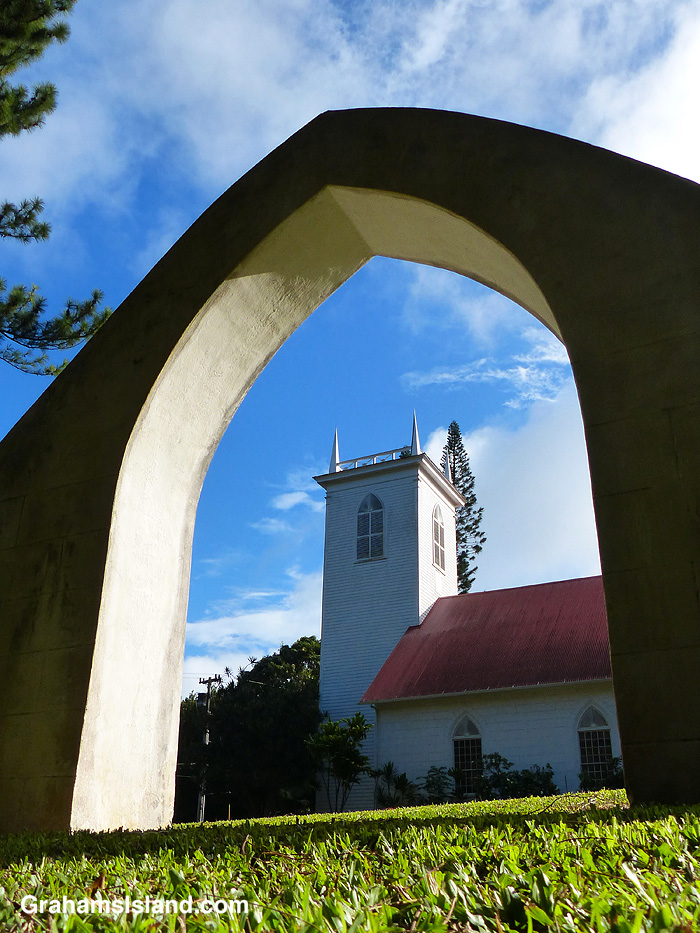
Kalāhikiola Congregational Church dates back to 1855 though the congregation had met in various structures in the area since 1837. The 1855 church was the first to be built of stone and, despite a few mishaps, it survived largely without problems until October of 2006, when a 6.7 magnitude earthquake caused extensive damage. It was rebuilt in the winter of 2009/2010.
Kiholo Bay sits midway between Kailua Kona and Kawaihae on the west side of the Big Island. There are two main access points to the bay. One is via a gravel road south of the Kiholo Scenic Overlook on the main highway. This road takes you down to Kiholo State Park Reserve where there’s a campground and access to the beaches. I usually go that way, but on my last visit I wanted to try the hike from the main road.
There’s an unmarked parking area north of the scenic overlook. From there it’s about a mile to the coast, along a dirt and gravel road. This passes through scrubby trees where it’s likely goats will be encountered. They’re abundant in this area. The private property alongside the road is well marked, as is the public trail through to the beach. This trail comes out near a funky building decorated with things the tide washed in.
I headed to the right, along the beach towards Wainanali’i lagoon. There are a couple of houses along here, a palm-circled pool, and usually a canoe or two under the trees. Beyond the houses, a small bridge traverses a channel which connects the ocean to Wainanali’i fish pond. This is believed to have been built by King Kamehameha I, as part of an extensive fish collection and farming operation in the bay.
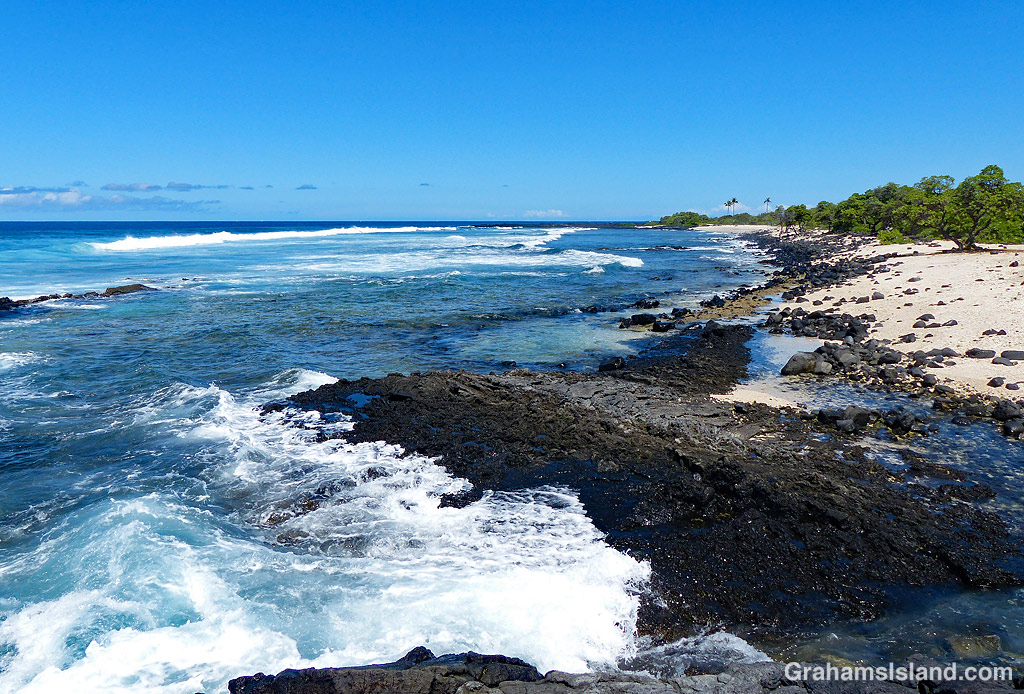
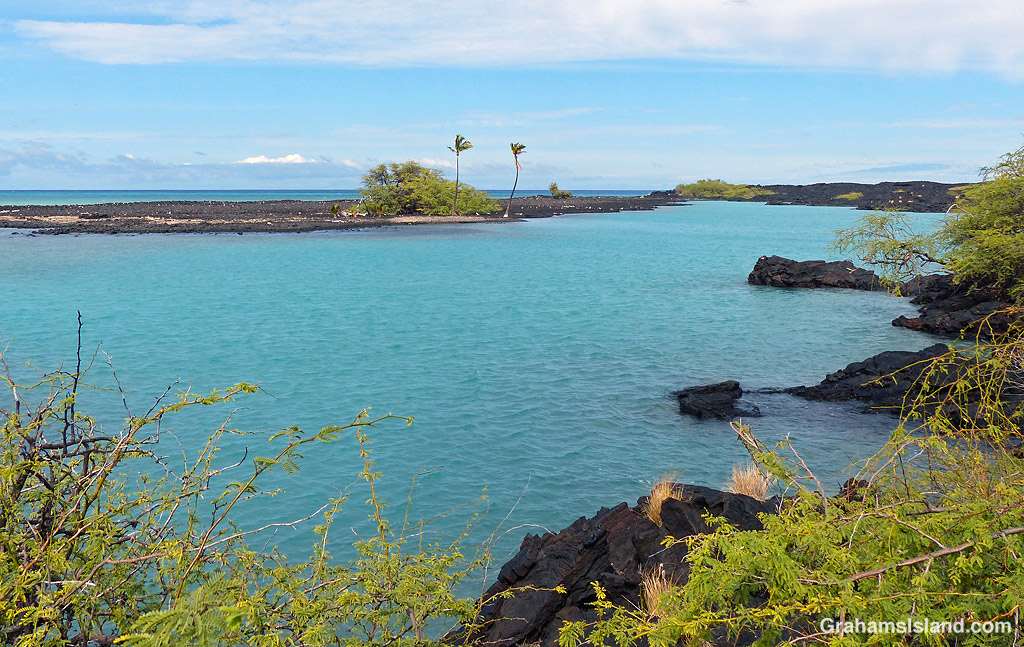
A bit farther along, a blue Kiholo Bay Fisheries Management Area sign marks where the trail forks. To the right, inland, it follows the old King’s Trail to Keawaiki. To the left, it hugs the shoreline heading north alongside Wainanali’i lagoon (top photo). The trail is loosely marked with white coral and/or cairns, but it’s not vital to follow them. I stick to the shoreline.
The lagoon is the remnant of a much larger fishpond, which was around 2 miles across and protected by a 20-foot wide lava rock wall. Much of it was destroyed by a lava flow from Mauna Loa’s 1859 eruption. Today, the lagoon is a prime area for seeing green turtles. They haul out on a rocky island marking the mouth of the lagoon and on the spit that separates it from the ocean. This is where they rest so it’s important not to get too close and disturb them. I also usually see turtles in the water. They putter along the edge in blue-green water, which can give them a wavy appearance. Small fish are abundant here and are often seen.
Once at the head of the lagoon I watched humpback whales splashing and slapping offshore. It’s possible to walk down the spit (not disturbing the turtles), and if it’s calm you can wade or swim across the lagoon entrance back to the trail. Following the coast northwards will take you to Keawaiki, but I retraced my steps until I got back to where I first reached the coast. Then I carried on along the beach.
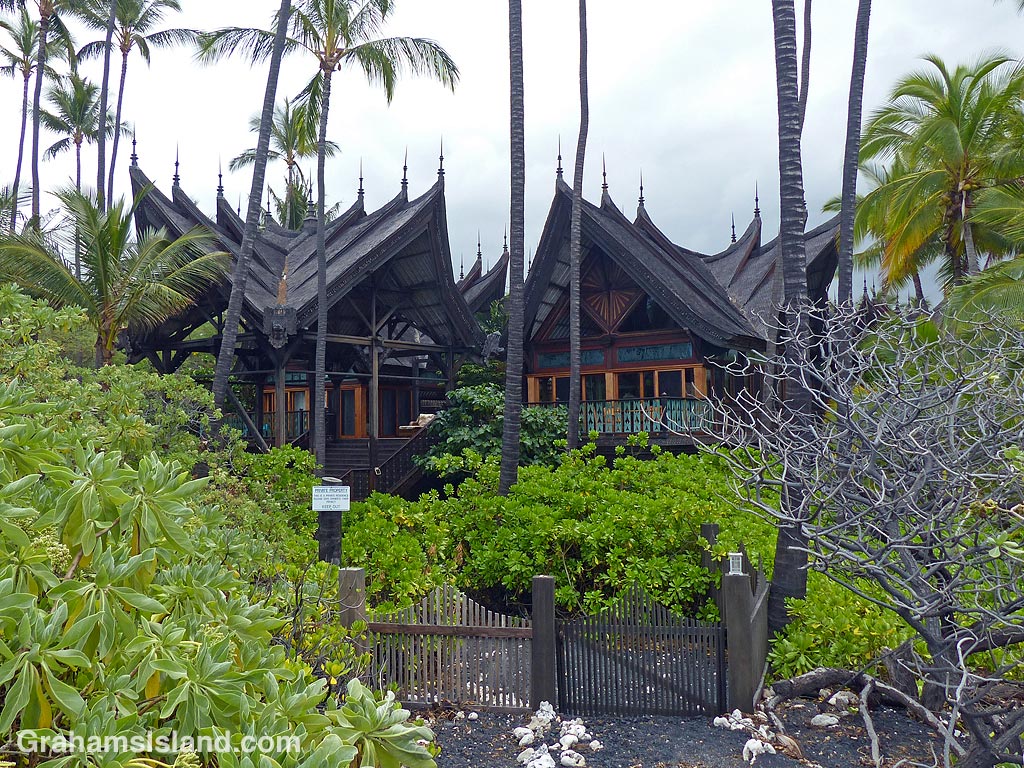
The waves were rolling in, good news for surfers. The beach here is sandy and vegetation borders it. If the tide’s in a bit of paddling is required. On the other side of this, some private houses border the beach including the Bali House and a sprawling, yellow structure. Farther along is the parking area for Kiholo State Park Reserve, back in the trees, followed by the Loretta Lynn house and the campground.
Here, along with several places along the walk, a fair number of birds can be seen including black-crowned night herons, wandering tattlers, Pacific golden plovers, yellow-billed cardinals, and northern mockingbirds.
The southern end of the park is marked by Waia’elepi anchialine pool. Anchialine pools form in volcanic rock and are connected underground to the ocean. The water is brackish, but the pools can be home to a wide variety of species. I saw goats drinking here as well as a variety of birds and insects flying about.
From there, I headed back to the car on the gravel road which parallels the coast and connects to the trail I came down on. My walk was about 5 or 6 miles, but I took more than 4 hours to cover that distance since I do tend to stop a lot!
For more walks worldwide, see Jo’s Monday Walks. Also posted in response to the current Friendly Friday challenge theme of ‘On The Way.’ See more responses here.
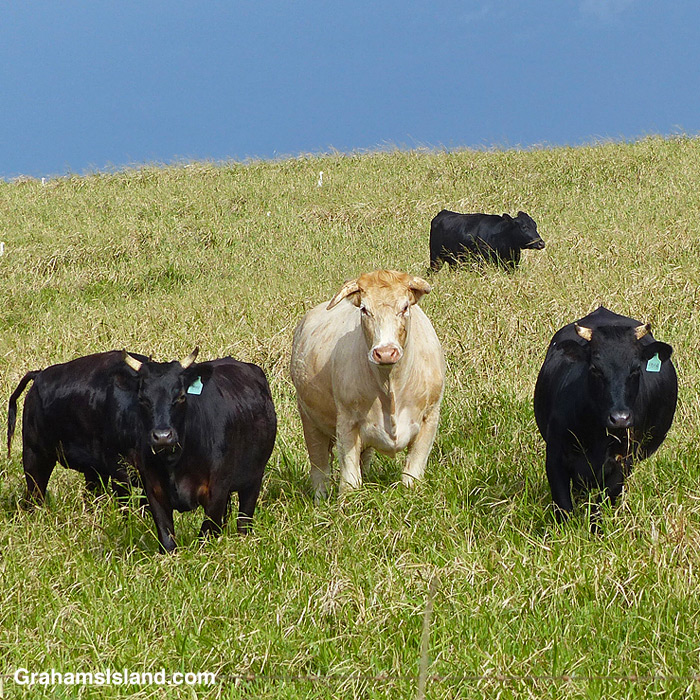
There are dairy cows and beef cattle here. Some are bigger than others.
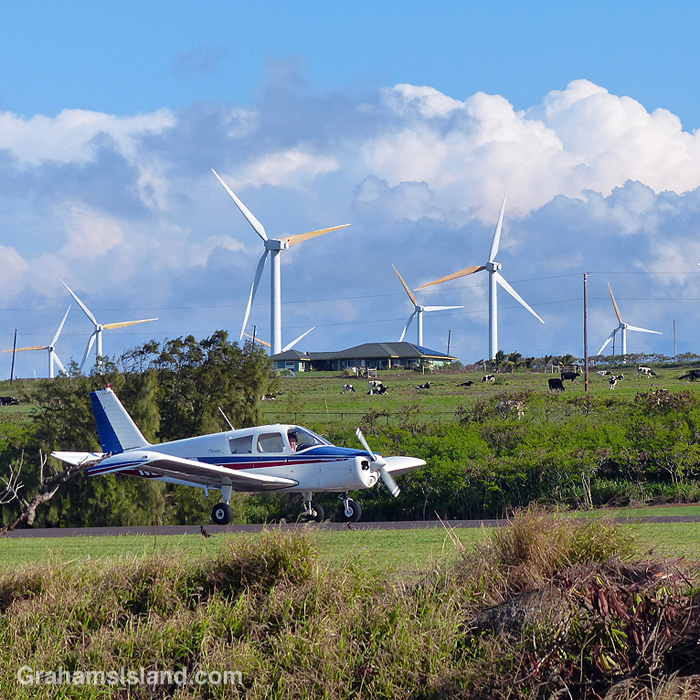
I often see sheep or cows on the road. These were trotting past the wind farm.
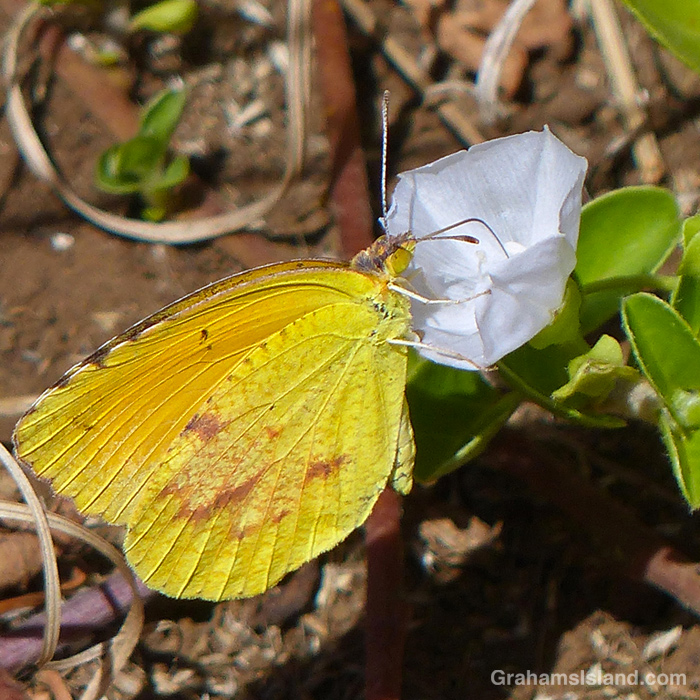
A sleepy orange butterfly on the flower of a native Jacquemontia sandwicensis vine.
A pair of nenes walk along the road outside the airport fence.
The newest addition to the landscape is this alien-looking sugar cane harvester.
Horse riders on the road along the coast.
Upolu is a good place to watch the sunset.
The view from Mo’okini Heiau towards a cloud-covered Maui.
A view of Maui from the top of the road to Upolu Airport.
This week’s Sunday Stills challenge theme is ‘Your Favorite Landscape.’ See more responses here.
When I think of the landscape at Upolu, it includes both the ocean that borders it and the skies above. They are, in my mind, integral to the place. But here, I’ve focussed on the land, a relatively small area of a few square miles where I walk most days. It’s rural, agricultural, and coastal. It’s historic and modern. It’s also a place I never return from feeling disappointed. There’s always something of note that I see or that happens when I’m there.
Also posted in response to Becky’s January Squares challenge theme of ‘Up.’ See more responses here.
The headquarters of Parker Ranch, founded in 1847 and one of the biggest ranches in the USA, can be found in the bucolic town of Waimea. It’s the heart of cattle country on the Big Island and where there’s cattle, there’s cowboys, but not here. Here in Hawaii, the cattle are tended by paniolos. That’s because, when the cattle industry grew, ranch hands were needed.
The first three came from California, then part of Mexico. These three vaqueros (Spanish for cowboys) spoke español, but the theory is that, because the Hawaiian language couldn’t handle the word español, it was converted to paniolo. The name stuck.
Over time, the local Hawaiians learned the skills associated with handling cattle. So well did they do this that, in 1908, three of them were entered in the Frontier Days World Championship in Cheyenne, Wyoming. Not only were they a huge hit with the crowds, but they also won titles. Ikua Purdy won the world steer-roping contest and was later voted into the National Rodeo Cowboy Hall of Fame. To commemorate those achievements this monument was commissioned. It arrived on the island in 2003 and today stands next to the main highway, on the edge of the parking lot of Parker Ranch Center, a large (for Waimea) shopping complex in the center of town.
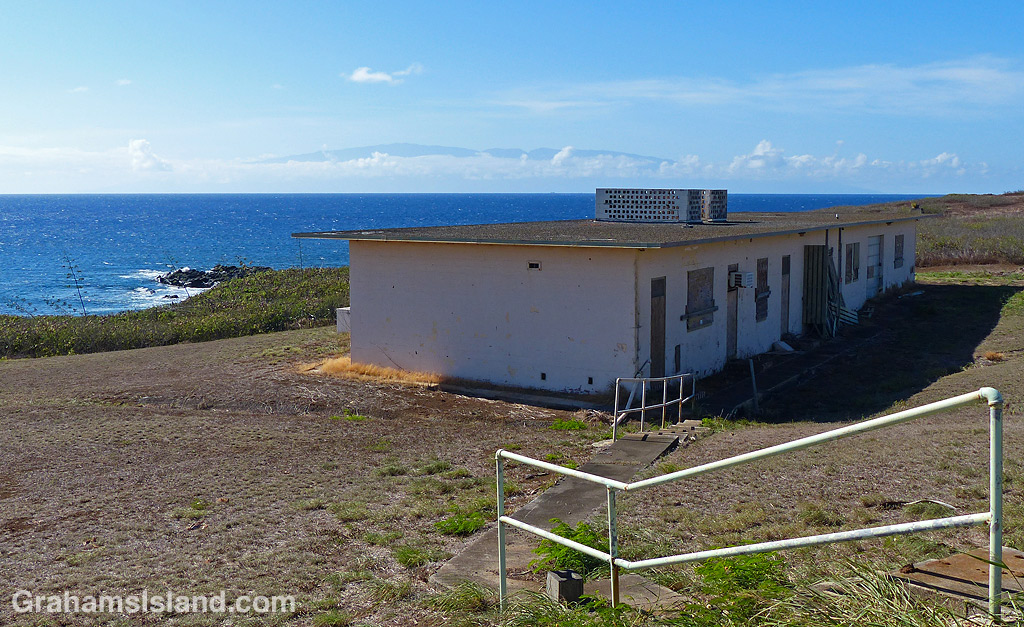
The Old Coast Guard Station near Upolu was constructed in 1944 as a Loran station. Loran was an early navigation positioning system. The original system was Loran A, but this was replaced by Loran C in the early 1960s.
Over the years there were changes to the buildings, staffing, and equipment at the station until, in 1993, the station closed. For many years not much happened. The buildings began a steady decline. The station had been built on two different land parcels and, upon closure, these ended up in the hands of the Hawaiian Homelands and Parker Ranch.
When I first moved to Hawaii, a local policeman used to live in one of the buildings. It was all fairly low key and mellow. When the policeman moved out, Parker Ranch put up no trespassing signs and had security personnel driving by to check the area. They stopped people from walking along the coastline for exercise or to fish because, God forbid that unauthorized people should set foot on any of the thousands of acres they own. (Yes, I was bitter about that attitude.)
Eventually, Parker Ranch sold their slice of the old station and the new owners refurbished the two buildings on that property (the blue buildings in the top photo). Regular people can now walk the coastline again as the very nice owners marked a path with coconut shells.
The rest of the station continues to slowly decay. Owned by Hawaiian Homelands, the chances of anything happening in my lifetime are remote.
For more information about the history of the Old Coast Guard Loran Station near Upolu, go to http://www.loran-history.info/upolu_point/upolu_point.htm. Scroll down to Documents and find the General Information Books for 1969, 1978, and 1988 for some interesting historical information about the station and the area.
This shell necklace was draped over the sign at King Kamehameha’s birthplace on the North Kohala coast. It was probably left there as an offering, a not unusual occurrence at such sites.