Category Archives: Hawaiian History

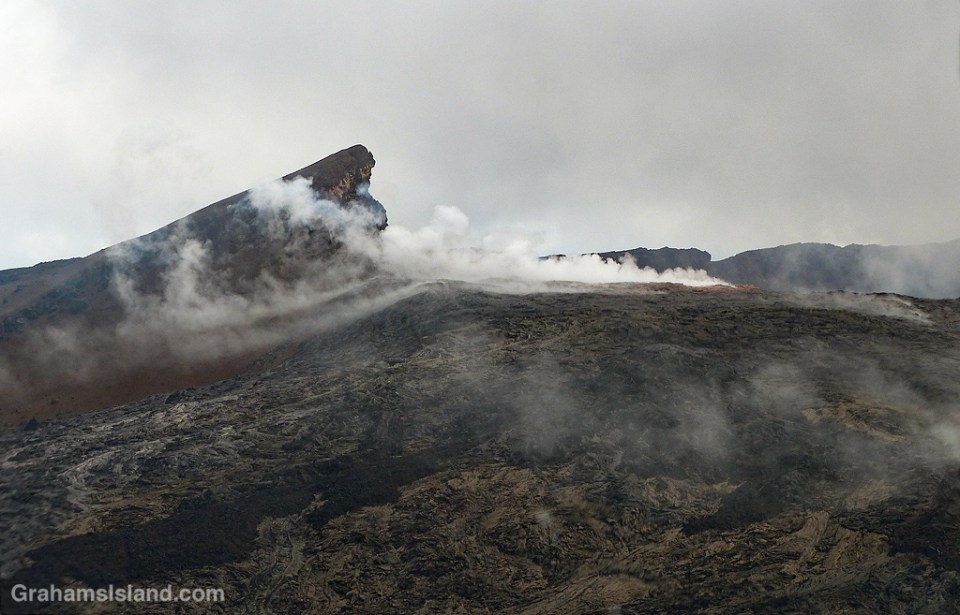
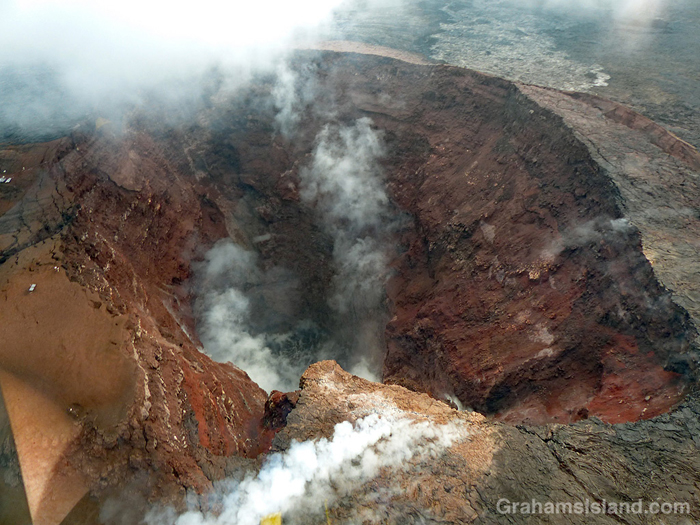
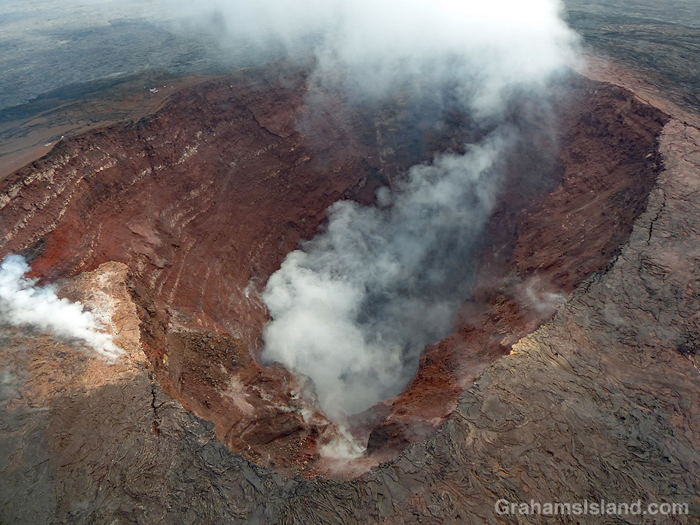
Pu’u O’o vent

Pu'u O'o vent

Pu'u O'o vent and steamPu'u O'o vent from aboveThis week’s Sunday Stills challenge theme is ‘Time.’ (See more responses here.) I had a couple of thoughts about this. The first is that the state of Hawaii is a kind of geologic timepiece. The Hawaiian islands exist because a magma source known as the Hawaii hotspot generates volcanic activity. This creates underwater seamounts that eventually break the surface to form new islands. Such a process is currently taking place with Lōʻihi Seamount, off the southeast coast of the Big Island. It’s about 3,000 feet below the surface but, if it continues its present activity, it will rise above sea level in another 10,000 to 100,000 years.

But if Hawaii is on a volcanic hotspot, why doesn’t it produce one volcano that just gets bigger and bigger? Well, the tectonic plate on which Hawaii sits is in constant motion to the northwest. So the volcanic activity generates an island, but as the plate moves, that island edges away from its creative source and the volcanic activity ceases. What happens then is that the winds and waves begin a long process of erosion until that island is reduced to an atoll and finally disappears below the ocean’s surface. We’re not talking months here. We’re talking millions of years for this process to take place.

Look at a map and you’ll see this chain of Hawaiian Islands stretching away to the northwest, the islands or atolls becoming progressively smaller until they disappear and return to being below-surface seamounts. And while I say this is a slow process, it can also be speedy. In October of this year, Hurricane Walaka ripped through the French Frigate Shoals, part of the northwest Hawaiian chain. Its passage completely removed the second largest island in the group, East Island, from the map. Researchers had been working there before the hurricane struck. After its passage, it was gone (more info here).

So Hawaii is an example of the geologic passage of time. But there’s another aspect of our view of time that is illustrated here. The photos are of Kilauea’s Pu’u O’o vent. Kilauea is one of the planet’s most active volcanoes and the Pu’u O’o vent had been more-or-less continuously active since 1983. Then, in May of this year, the activity in this vent, and in the summit vent at Halema’uma’u Crater, ceased. The magma drained from these places and traveled down the east rift zone of the volcano before emerging in a residential subdivision, Leilani Estates, in the southeast corner of the island. This new eruption produced a lava flow that reached the ocean, destroying more than 700 structures en route, but adding hundreds of acres to the Big Island coastline.

What’s the time aspect of this? Well, it’s part of the geologic time process noted above. But there’s another way of looking at it. Kilauea has been erupting so long and so regularly that it’s been a little bit taken for granted. “Oh, lava’s flowing into the ocean? You know, I’m really busy right now. I’ll catch it later.” “The summit vent is spilling onto Halema’uma’u Crater’s floor? I’ll check that out next time I’m down that way.”

I consider myself fortunate that I got to see the firehose of lava entering the sea after a cliff collapse (here). Next day, following another cliff collapse, it was no longer visible. And in April of this year I went down to see the summit lava lake (here) bubbling up to the crater floor and visible from Jagger Museum. Two weeks later, the level had dropped a thousand feet. It continued to fall.

I might never see these things again in my lifetime, but at the time, there seemed to be lots of time to visit. But even events happening in a long, geologic timeframe might occur in the space of a week, a day, even an hour. It’s a reminder to me that each moment is something fleeting, perhaps something special, something to pay attention to.

These photos are of Pu’u O’o vent in late September of this year. No lava is visible in the vent, but it’s still hot enough that rainfall generates steam, which is what’s visible here. It was quite dramatic to pass over this vent, which for 35 years has pumped lava out onto the surrounding landscape.
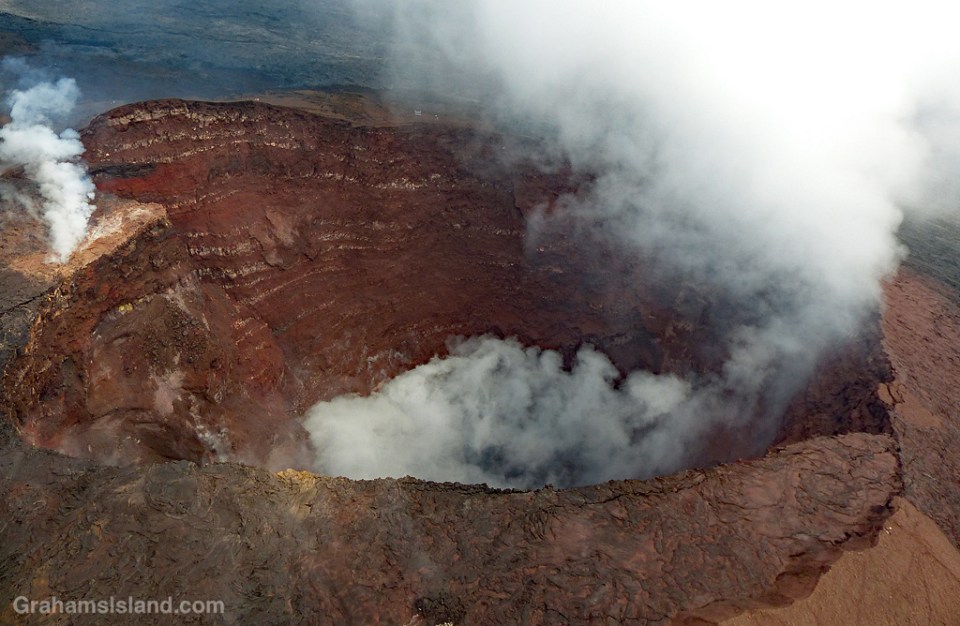

Pu'u O'o vent steam

Better Days: Wrecked bomber

Better-Days-Wrecked Bomber in trees

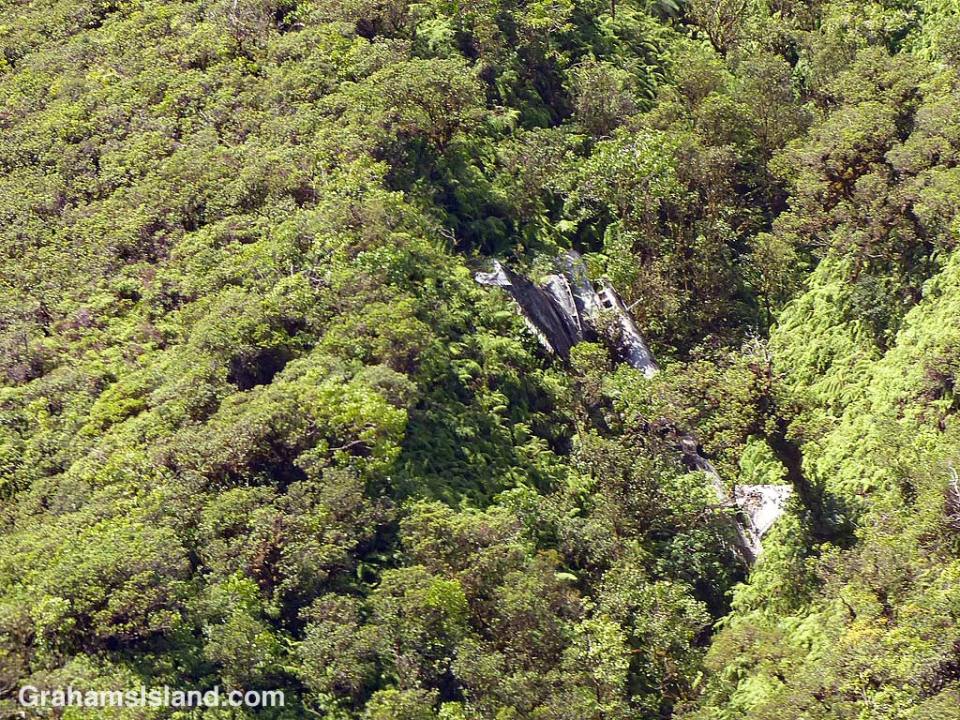
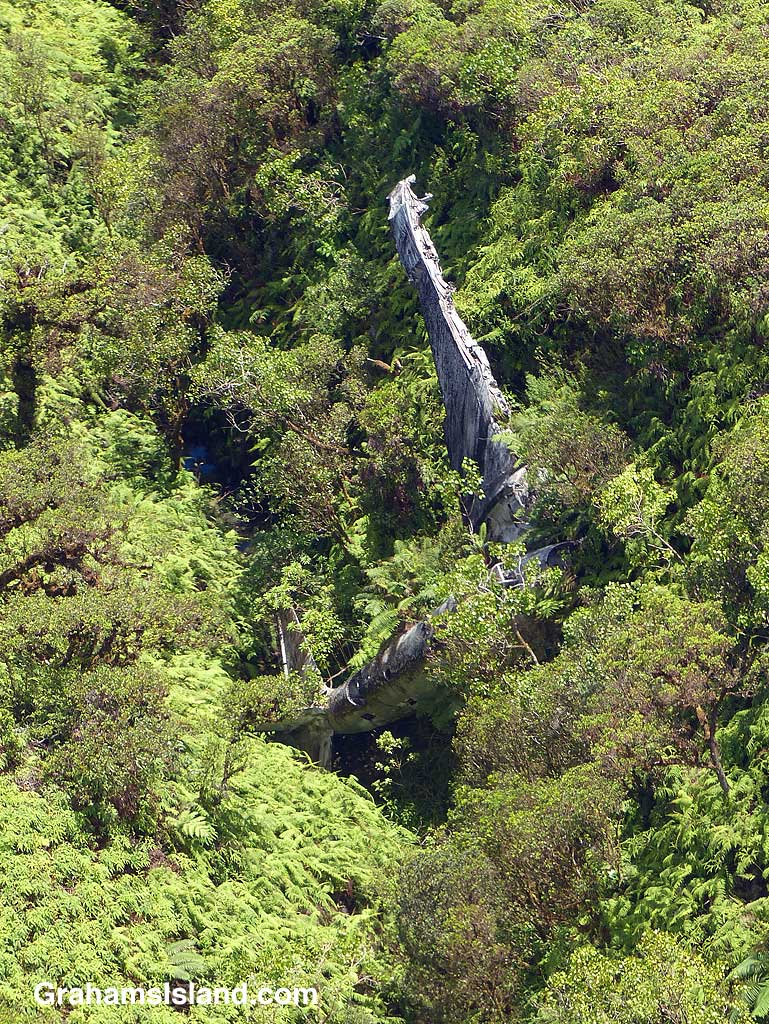
Better-Days-Wrecked Bomber in ravineOn the evening of Tuesday, February 25, 1941 this twin-engined B-18 bomber was part of a group of four aircraft on a night training mission. They had started out from Hickam Field on Oahu. Not far from Hilo the plane lost its port engine when a bearing failed. The pilot decided to try and reach Suiter Field (now known as Upolu Airport) at the island’s northern tip. It was not to be. Flying on only one engine, the plane lost altitude. The crew thought they were over the sea, but suddenly a mountain appeared in front of them. The pilot yanked on the flight yoke wheel and the plane stalled and flopped into the trees around 10 p.m.. Incredibly only one crewman was slightly injured.
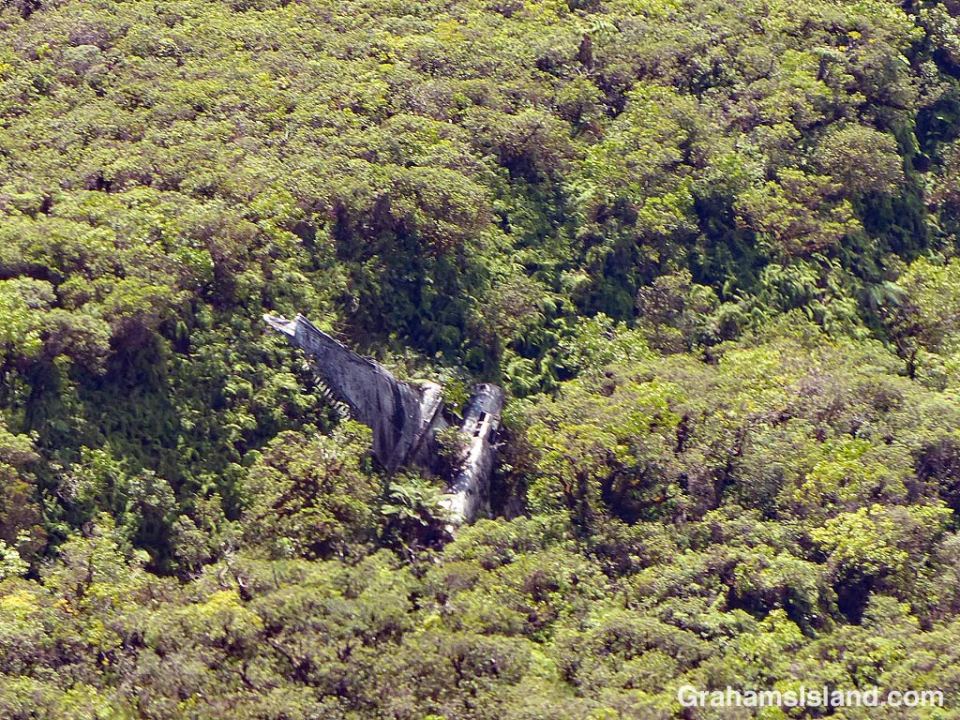
Search aircraft from Hickam Field found the plane the next morning around 9 a.m.. The nose of the plane was hanging over a 75-foot deep ravine about 3,500 feet up on the northern side of Kohala Mountain. It was one of the most inaccessible places on the island. A rescue operation was started, but it was Thursday noon before it reached the crew.

Over the years, the aircraft has slid into the ravine which is where it rests today. As these photos show, the plane’s condition has deteriorated and it is increasingly being engulfed by trees. But it is still quite easily spotted from the air. On the ground, it remains one of the most inaccessible spots on the island.

It’s also worth noting that just nine months after this crash, almost all the B-18 bombers based at Hickam Field were destroyed on the ground during the attack on Pearl Harbor. 77 years on, this B-18, in its remote resting place, is one of only a handful remaining in existence.

For more information about this aircraft and the crash, search online for Big Island Bomber – hiavps.com or go to pacificwrecks.com/aircraft/b-18/36-446.html.

Better-Days-Wrecked Bomber

Place of Refuge from the water

Place of Refuge from the water

This is a view of Pu’uhonua o Hōnaunau National Historical Park, otherwise known as Place of Refuge. The pu’uhonua or place of refuge was a place that offered sanctuary to those who had broken laws or been defeated in battle. Reaching this spot meant they’d be spared and allowed to go home.

So this view is one that a young frightened warrior might see while trying to reach that spot. Hale o Keawe, the small structure with the steeply pitched roof, can be seen in the center of the photo. It sits on the edge of the pu’uhonua. To the right of it is safety; to the left death.

Fortunately that wasn’t my choice. I was just looking at fish.

Civilian Conservation Corps Cabin on Mauna Kea

CCC Cabin and water tank Mauna Kea

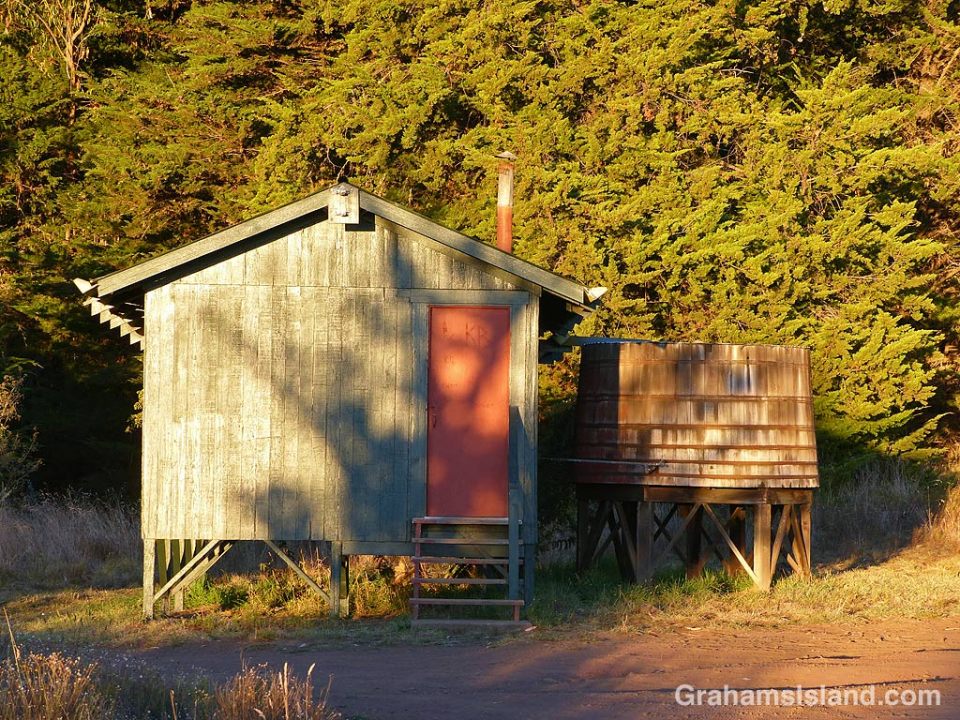
This Civilian Conservation Corps (CCC) Cabin is one of seven that were built around Mauna Kea in the 1930s. The CCC was a public work relief program to create jobs during the Great Depression. It focused on the conservation of resources on government-owned lands.

The seven cabins on Mauna Kea were used by crews working on the construction of sheep-proof fencing. The goal was to remove sheep from parts of Mauna Kea in order to protect the high-elevation dry forest which was rapidly being destroyed.

This cabin is just above the Palila Forest Discovery Trail on the southwest slopes of Mauna Kea.

Posted in response to this week’s Sunday Stills challenge on the theme of ‘Work.’ See more responses here.

CCC Cabin Mauna Kea

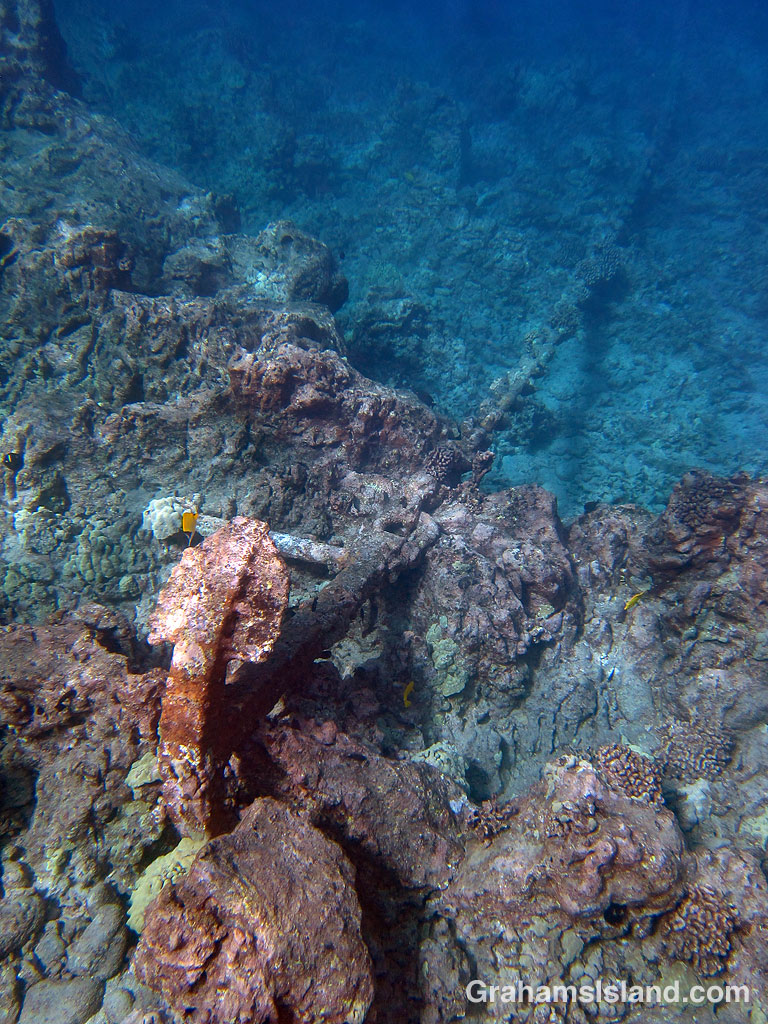
An old abandoned anchor

Sunken Anchor

Sunken Anchor and chainThis week’s Sunday Stills challenge theme is ‘Objects over 100 years old.’ (See more responses here.)
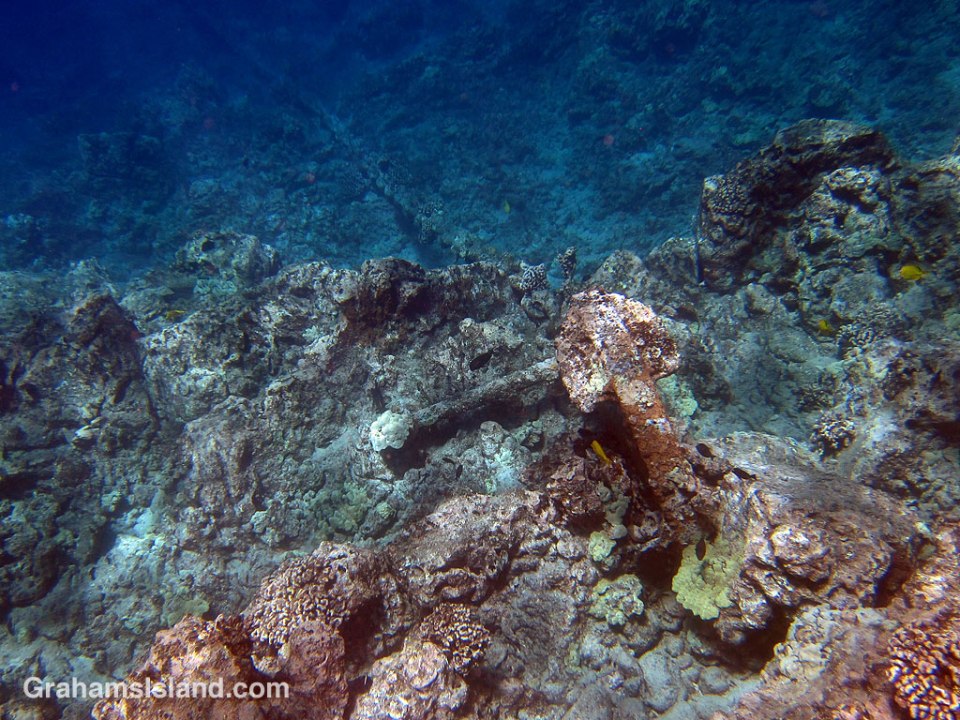
I can’t say for certain that this anchor and chain is more than 100 years old, but it almost certainly is. In the late 1800s and early 1900s, North Kohala was the center of the sugar industry with many plantations and several mills. This anchor likely dates from that time. It’s located in the bay where sugar used to be loaded onto ships.

I suspect the anchor isn’t lost from a ship, since it’s located in shallow water close to shore, with the chain leading out to deeper water – the opposite arrangement of how a ship would normally anchor. Instead, I think the anchor and chain were part of an offshore anchoring system used at the harbor. A ship would drop its anchor from the bow in deep water and attach to the anchoring system from the stern. This would keep the ship fairly stable and make the transfer of cargo, from small boats, easier.

After the sugar industry shut down, a lot of buildings and equipment were abandoned, and in the water, the anchoring system was left to rust.

Signs: Mo’okini Heiau

Signs-Mo'okini Heiau

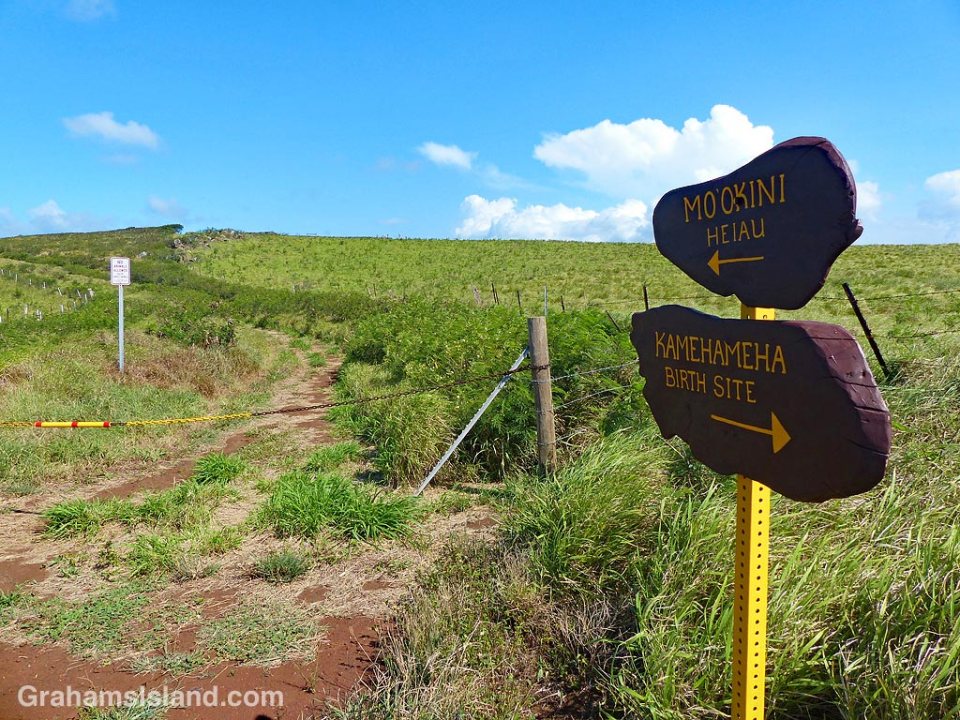
Mo’okini Heiau is located just off one of my regular walks. The old signs for the heiau and the Kamehameha birth site fell from their original spot, tacked on a fence, some years ago. Since then, the signs have been wedged into a barbed wire fence, from which they regularly fell into the grass.

When I noticed this, I’d root the signs out and wedge them back in the fence. I believe other people also did this. At some point, one of the signs split in two, so there were three pieces to try and arrange in some way that they wouldn’t immediately fall down again.

I kept thinking I should bring some wire and a drill and try and put the signs back together again, maybe attach them to a fence post, but I only remembered this good intention when I was picking the signs out of the grass.

The grounds of the heiau are maintained by staff presumably contracted by the county or state. However, the area in the vicinity of the signs never got much attention except when, a couple of years ago, a sign prohibiting animals (on the left of the photo) suddenly appeared. I have a fondness for that sign because the chance of anyone enforcing that regulation is right up there with me winning three different lotteries on the same day (and Hawaii doesn’t have lotteries).

So imagine my surprise the other day when I reached this point in my walk and saw this spiffy new sign. Two new boards attached to a brightly painted pole securely set in a rock. I was giddy with shock and excitement (yes, I don’t get out much). If an alien spaceship had landed I wouldn’t have been more surprised. Note too the red and yellow paint on the chain across the trail to the heiau, and the well-supported post that fell down about a year ago.

Folks, forget the volcano. You want to see something truly amazing on the Big Island, come up to North Kohala and check out these signs while they’re still standing.

King Kamehameha statues

King Kamehameha statue KapaauKing Kamehameha statue Honolulu

These two photos are of statues of King Kamehameha I, the king who first united the Hawaiian Islands under one leader. On top, draped in leis from last Monday’s Kamehameha Day celebrations, is the statue at Kapaau, here on the Big Island. Below is the statue in Honolulu. It sits in front of the Aliʻiōlani Hale, which housed the government of the Kingdom of Hawaiʻi and the Republic of Hawaiʻi, and is currently home to the Hawaiʻi State Supreme Court.

Back in 1878, a statue of the King was commissioned for display in Honolulu. The commission was given to American artist Thomas Ridgeway Gould, and in 1880 his plaster model was sent to Paris to be cast, before being shipped to Hawaii. Alas, it never made it. The ship transporting the statue caught fire and sank off of the Falkland Islands.

Fortunately, the statue was insured, so a replacement was ordered. While this process was underway, the original statue turned up! Salvaged by fishermen, it was sold to a British ship captain who recognized it. He, in turn, sold it to the Hawaiian government, which now found itself in possession of identical twin statues. But the statues weren’t identical. The replacement statue was pristine and resplendent with gold detailing. The original was missing a hand and had a broken spear, and had suffered a good deal of fire damage.

The government decided to erect the replacement statue in Honolulu and the original was restored and sent to Kapaau, near Kamehameha’s birthplace. However, the original was corroded from its time in the sea so, in the early 1900s, local residents began to paint the statue, both to prevent further corrosion and to make it more lifelike.

By the end of the century, the statue was in bad shape and in 1996 conservator Glenn Wharton was hired to assess its condition. In his book, The Painted King: Art, Activism, and Authenticity in Hawaii, he recalls being startled by what he found, ‘A larger-than-life brass figure painted over in brown, black, and yellow with “white toenails and fingernails and penetrating black eyes with small white brush strokes for highlights. . . . It looked more like a piece of folk art than a nineteenth-century heroic monument.”’

For the next few years Wharton led a community discussion about how to save the statue, including the tricky question of whether it should be restored to its original bronze and gold finish or continue the painted alternative the community had grown up with. In the end the community voted to keep the painted finish and in 2001 the statue was restored in this way and rededicated.

A third statue of King Kamehameha I was commissioned after statehood in 1959, for installation in the U.S. Statuary Hall in Washington DC. However, this statue wasn’t cast from the original molds, but from molds taken of the Honolulu statue.

Posted in response to this week’s Sunday Stills challenge on the theme of ‘Twin.’ See more responses here.

Post Office Building, Honolulu

Post Office Building Honolulu

Couple at Post Office Building HonoluluAn off-island photo from my recent jaunt to Honolulu. This is the old U.S. Post Office, Custom House, and Court House, which is still in use as a post office today. The building is one of many historical buildings in the downtown area.

This building dates from 1922 and, according to the handy guide from historichawaii.org, ‘This classic Mediterranean-style structure features large roof overhangs, shaded arcades, open interior courtyards, spacious porticos, and two towers.’

Not a bad spot to sit and have lunch.