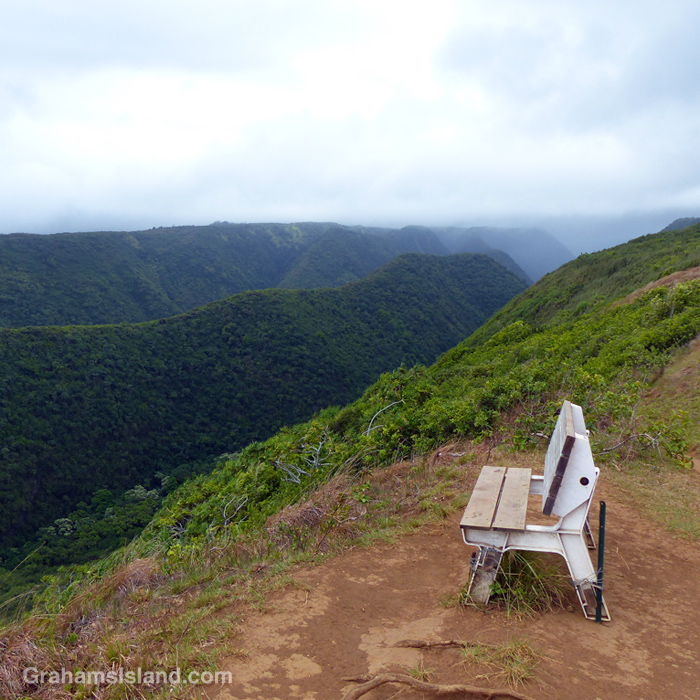
I like this bench on the steep entry path at Hawai’i Tropical Bioreserve & Garden, for its simplicity and practicality.
For more information about Hawai’i Tropical Bioreserve & Garden, go to htbg.com.

I like this bench on the steep entry path at Hawai’i Tropical Bioreserve & Garden, for its simplicity and practicality.
For more information about Hawai’i Tropical Bioreserve & Garden, go to htbg.com.

This sign stands behind the little beach below Puʻukoholā Heiau at Kawaihae. Typically, When a shark is sighted, a temporary warning sign is put up, then removed after a few days. This sign is permanent. The reason for this is that beyond this beach is Pelekane Bay and that’s the site of an underwater heiau dedicated to sharks.
This heiau, called Hale o Kapuni, was built by a chief for whom sharks were considered carriers of the spirits of his ancestors. Human sacrifices were carried out on the beach and afterwards, the bodies were believed to have been placed at the heiau for the sharks. Those days are long gone, but the bay and surrounding area is still home to a large population of sharks, hence the sign.
For more information, go to https://www.nps.gov/puhe/index.htm


This week’s Sunday Stills color challenge is ‘Mustard.’ See more responses here.
Giant earth moving equipment reminds me of alien robots in space adventure movies. These mustard-colored aliens were resting after a day of destroying the earth, or at least rearranging its contours a bit.


I posted here about the spiffy new Kaulana Manu Nature Trail facilities. This is another feature of the upgrade. The actual trailhead is 100 yards or so up the old road from the parking area. I would have thought that negotiating this stretch safely could have been achieved by the placement of a map (which is there) and a couple of clear, but not ostentatious arrows.
Apparently, the trail planners have less faith in the public being able to negotiate the simple transition from car park to trail. Instead we have this solution, a series of footprints to guide even direction-challenged walkers.
There’s a problem though. I tried walking in these footsteps and it made me tired and fearful that I was going to pull a muscle somewhere. Plus, it seems very discriminatory to pigeon-toed people.

A tug brings its barge to a stop before positioning it alongside the wharf at Kawaihae for unloading. This is an almost daily, early morning occurrence. In the background is Mauna Loa, which is Hawaiian for ‘long mountain.’


I came across this scene at Hawi Wind Farm on my way down to walk at Upolu. I’ve seen similar before, various maintenance tasks being performed on the turbines. In this case, the crew appeared to be cleaning rust streaks and then painting them.
When I zoomed in I was taken by a few thing. First up was the shadows thrown off by the man up in the air. I thought this shadow had the look of an old time whaler. When I zoomed in, I was charmed that they were to be using a roller to paint these rather large turbines. Granted, they were just patching bad areas, but it seemed like they might use something giving quicker coverage. I also liked the patterns made by the painted patches, as if some kind of code was involved.
Oh, and yes, they missed a bit!

The setting sun illuminates a splash of water off a wave.

Sometimes, when I’m walking along the coast, the first thing that alerts me to the presence of a bird is its shadow passing over me. This happened again a few days ago and I glanced up to see this White-tailed Tropicbird practically over my head and not by very much. By the time I wrestled my camera out the bird had glided out over the water and away. I watched it receding and put my camera away.

Moments later, I realized the bird was riding the wind back in my direction. I whisked my camera out and started doing pirouettes as it skimmed closer and turned again when overhead. Again it slid away towards the water. It repeated this maneuver two or three times before heading into the wind and out of sight.


I put my camera away again, hoping I had some good shots, and carried on with my walk. About a half mile father on, a shadow passed over me. I looked up and there was the bird again. I assumed it was the same one, and had snuck behind me while I wasn’t looking. This time the bird drifted out into the channel and disappeared towards Maui. These photos are from that encounter.
The next day, walking in the same area, I kept a watchful eye out for a reappearance, but didn’t see a thing … until a shadow passed over me. There it was again. This time the bird kept going and I didn’t even try to take a photo. It disappeared from view. A couple of minutes later, another shadow passed over. This was a different bird, following the first, so perhaps the day before had also been two birds.
I see these graceful birds once in awhile on my walks in this area, but I think large numbers of them can be found farther along the coast between Pololu and Waipio, nesting on the cliffs.