Category Archives: Places

Goats hazard

Goats on the fairway

Here’s a view of part of the golf course at the Westin Hapuna Beach Resort on the Kohala coast. Besides the usual trees and bunkers to challenge golfers, there’s a generous sprinkling of goats. I liked the pastoral feel of this photo, but if I were a golfer and my ball came to rest within a club’s length of some of these goats, I’d be inclined to drop a new ball a safe distance away.

Signs: Boiling Pots

Signs-Boiling Pots dangers

Boiling Pots is part of Wailuku River State Park, in Hilo, along with Rainbow Falls. It features a series of small falls and pools. So why the name? When the river runs fast, those pools roil and bubble as if boiling.

The park overlooks these pools and access to the pools is forbidden, hence these signs. However, people go down there all the time and a few die every year. When people do get swept away, rescue divers usually spend 24 to 48 hours searching the river, at some considerable risk to themselves. Sometimes the body turns up several weeks later, swept into some unlikely spot. Sometimes it’s never found.

Going in circles

Tug and barge 1Tug and barge 2Tug and barge 3Tug and barge 4Tug and barge 5

Driving towards Kawaihae, I noticed the inter-island barge a mile or two short of the harbor entrance. But instead of heading in, it was stooging around, going in circles or possibly figure eights. Clearly the harbor wasn’t ready to receive it. Still, there are many worse things that can happen than being obliged to make gentle loops off the coast of the Big Island on a beautiful sunny morning.

Clerodendrum paniculatum

Clerodendrum paniculatum flowers

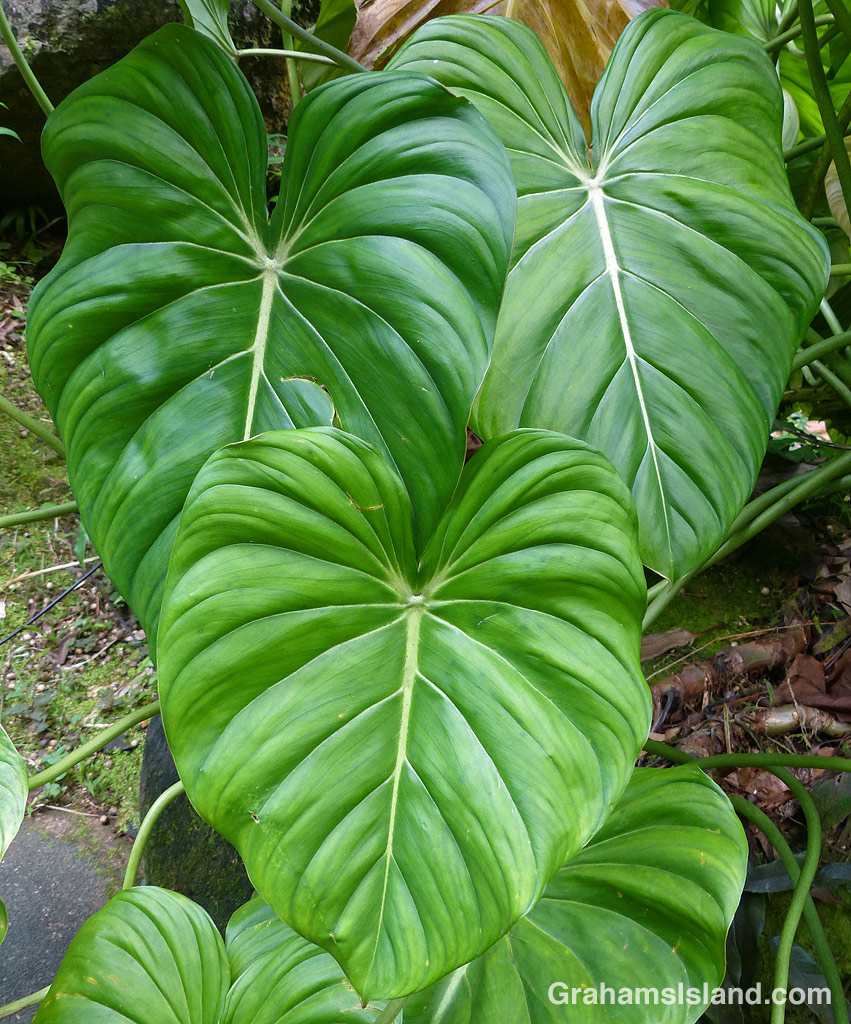
Clerodendrum paniculatumClerodendrum paniculatum is known as the pagoda plant. When I last visited Hawaii Tropical Botanical Garden in mid July it seemed like there were fewer plants in bloom than when I’ve visited at other times of the year. But the pagoda plants were rampant and putting on quite a show.

For more information about Hawaii Tropical Botanical Garden, go to htbg.com.

An old abandoned anchor

Sunken Anchor

Sunken Anchor and chainThis week’s Sunday Stills challenge theme is ‘Objects over 100 years old.’ (See more responses here.)

I can’t say for certain that this anchor and chain is more than 100 years old, but it almost certainly is. In the late 1800s and early 1900s, North Kohala was the center of the sugar industry with many plantations and several mills. This anchor likely dates from that time. It’s located in the bay where sugar used to be loaded onto ships.

I suspect the anchor isn’t lost from a ship, since it’s located in shallow water close to shore, with the chain leading out to deeper water – the opposite arrangement of how a ship would normally anchor. Instead, I think the anchor and chain were part of an offshore anchoring system used at the harbor. A ship would drop its anchor from the bow in deep water and attach to the anchoring system from the stern. This would keep the ship fairly stable and make the transfer of cargo, from small boats, easier.

After the sugar industry shut down, a lot of buildings and equipment were abandoned, and in the water, the anchoring system was left to rust.

Rainbows on the water

Rainbow on the water

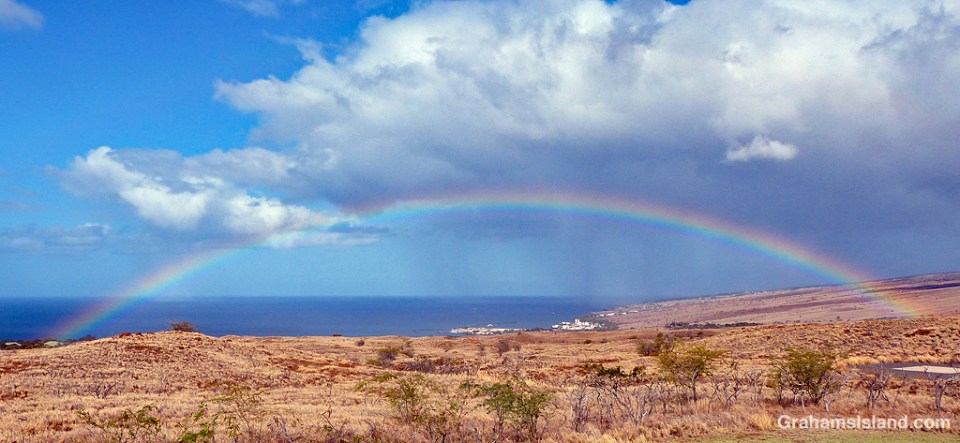
During a recent swim, I was lucky enough to see this gorgeous double rainbow. I took several photos and this one is actually a composite. In the best rainbow photo the water looked a bit flat, but in photos that gave a glimpse below the water’s surface the rainbow wasn’t as good. So I combined the best of both and it came out pretty good I think, especially given my rudimentary skills in my Photoshop Elements.

Punalu’u turtles

Punaluu turtles resting

Turtles are creatures of the water. The only reason they have to venture ashore is to lay eggs, but in Hawaii, green turtles like to find a beach and spend a lazy day basking in the sunshine. This helps them conserve energy and keeps them safe from sharks.

On the Big Island there are a number of places where turtles are frequently seen on shore. One of them is Punalu’u Beach Park, on the Kau coast, which has a lovely black sand beach ideal for getting a bit of rest. Well, it would be ideal except for that most annoying and obtuse of creatures, the human.

There are apparently large numbers of people who don’t know how to read the numerous signs telling them to keep their distance from the turtles. There are a fair number of people who think the world would be a better place if only there existed a photo of them sitting beside or on top of a turtle.

These days, park staff or volunteers tape off the area where the turtles are resting. This seems to help. The bottom photo was taken from behind the tape with a moderate telephoto lens so it’s not like anyone’s being deprived of getting a good view.

Posted in response to this week’s Sunday Stills challenge on the theme of ‘Lazy Days.’ See more responses here.

Punaluu turtle resting

A’a and pahoehoe lava

A'a and pahoehoe lava

This photo shows the two main types of lava found on the Big Island. On the left is pahoehoe lava and to the right, a’a lava. They’re noticeably different. Pahoehoe lava is typically rounded and smoother, and the height of the flow is quite modest. A’a flows are characterized by a rough, clinker surface and the flow height is greater. Both types of lava can be produced by the same eruption and even in the same flow, depending on conditions.

Pahoehoe flows occur when lava is hot and fluid. Typically, pahoehoe flows result from an eruption that outputs lava at a lower rate, has a lower flow rate and a slower moving flow front. The slower movement of the flow allows a skin to form on the surface and this insulates the lava within. The flow is actually made up of a large number of ‘toes.’ Each toe flows for a short time, a matter of minutes. When it stops, the lava inside causes the toe to expand until the skin cracks and releases a new toe.

A’a flows are more viscous, but with a higher flow rate and faster flow front. The lava in the center of the flow is very dense with a layer of rough clinker on top. As the flow advances, the front tumbles over itself breaking into more rough pieces.

It’s easy to see from the photo that walking is much easier over pahoehoe lava than a’a lava. That’s when it’s cooled of course. When it’s red hot and flowing, it’s best not to get too close.

This flow was on the north side of Mauna Loa, looking across to Mauna Kea.

For a more thorough description of the difference between a’a and pahoehoe lava, go to http://volcano.oregonstate.edu/book/export/html/131