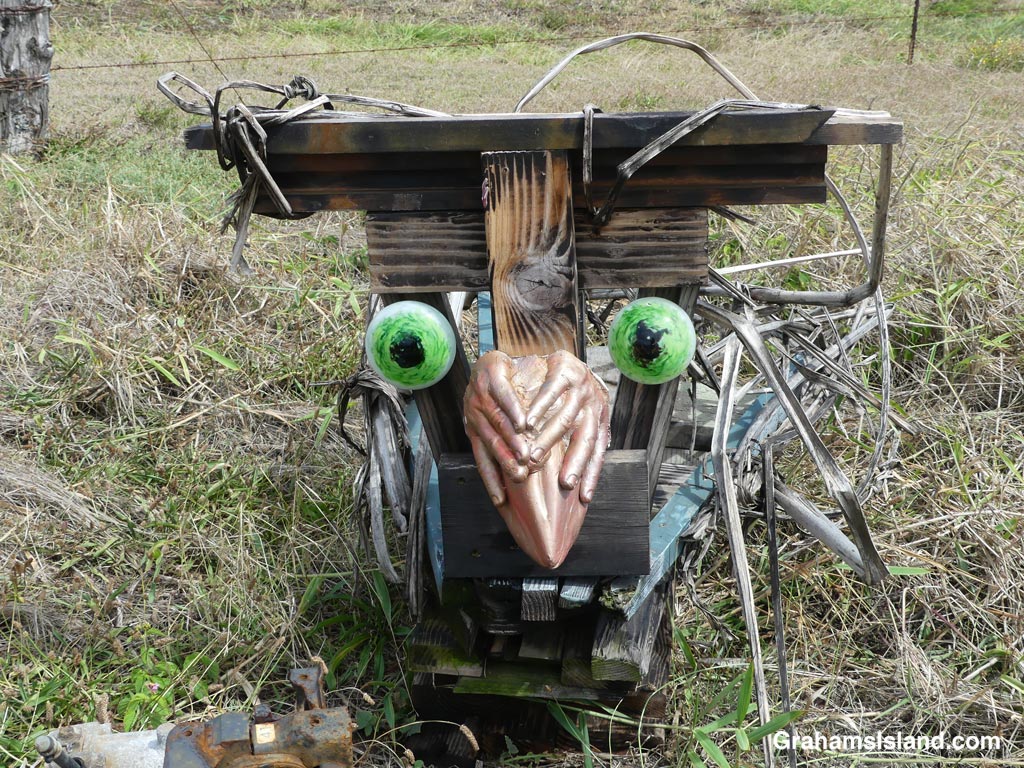
I came across this near the end of my walk yesterday. Definitely a contender for the weirdest photo I’ve ever posted.
Posted for Bushboy’s Last on the Card photo challenge. See more here.

I came across this near the end of my walk yesterday. Definitely a contender for the weirdest photo I’ve ever posted.
Posted for Bushboy’s Last on the Card photo challenge. See more here.
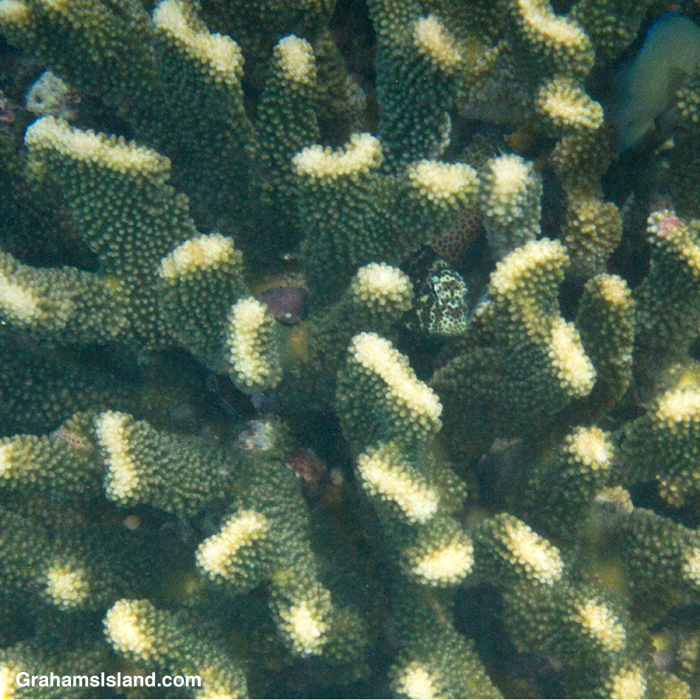
I took this photo of a head of Cauliflower Coral because I was happy about how healthy it looked. Then I saw that I was being watched. This Spotted Coral Blenny was wedged into the coral head, as they do, clearly waiting for me to move on.
Well, it is the last of the month, so time for me to move forward into June and for the blenny to go about his business.
Posted for Becky’s Squares: Move Forward, Reconstruct, Renew, and/or are Burgeoning. See more responses here.

If anyone knows anything about burgeoning, it would be bees. These had found some Tree Heliotrope flowers coming into bloom and were all over them!
Posted for Becky’s Squares: Move Forward, Reconstruct, Renew, and/or are Burgeoning. See more responses here.


Next door the Mauna Kea Visitor Center is an enclosed area where Mauna Kea Silverswords (Argyroxiphium sandwicense subsp. sandwicense) grow. These silverswords are closely related to species found on Mauna Loa and Haleakala on Maui. All silverswords are at risk of extinction. The reasons are the usual suspects: humans, feral sheep and goats, climate change. They also suffer from a lack of genetic diversity. The current burgeoning population of more than 8,000 has been produced from only six wild plants.
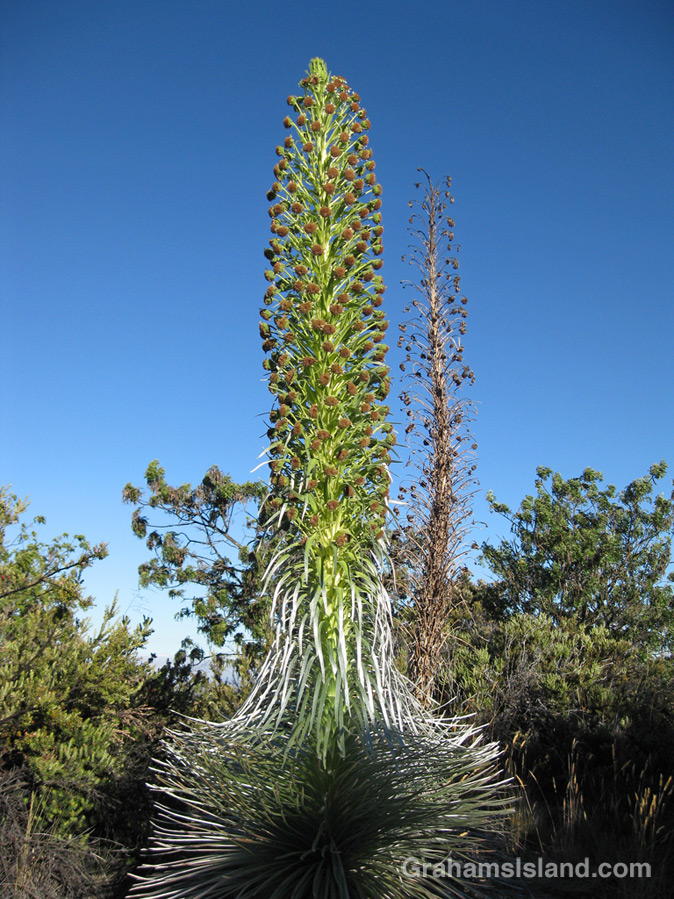
Silverswords can grow for 30 years or more, but once they bloom, they die. I haven’t seen a Mauna Kea Silversword blooming, but I was lucky enough to see Mauna Loa Silverswords blooming not long after I moved to the island (here). The second photo shows one of those plants in bloom. It was over six feet tall!
Posted for Becky’s Squares: Move Forward, Reconstruct, Renew, and/or are Burgeoning. See more responses here.

The idea of The Numbers Game is to enter a number into the search bar of your computer and then post a selection of the photos that turn up. This week’s number is 144. Captions are on the photos. You can see more responses here.
Also posted for Becky’s Squares: Move Forward, Reconstruct, Renew, and/or are Burgeoning. See more responses here.



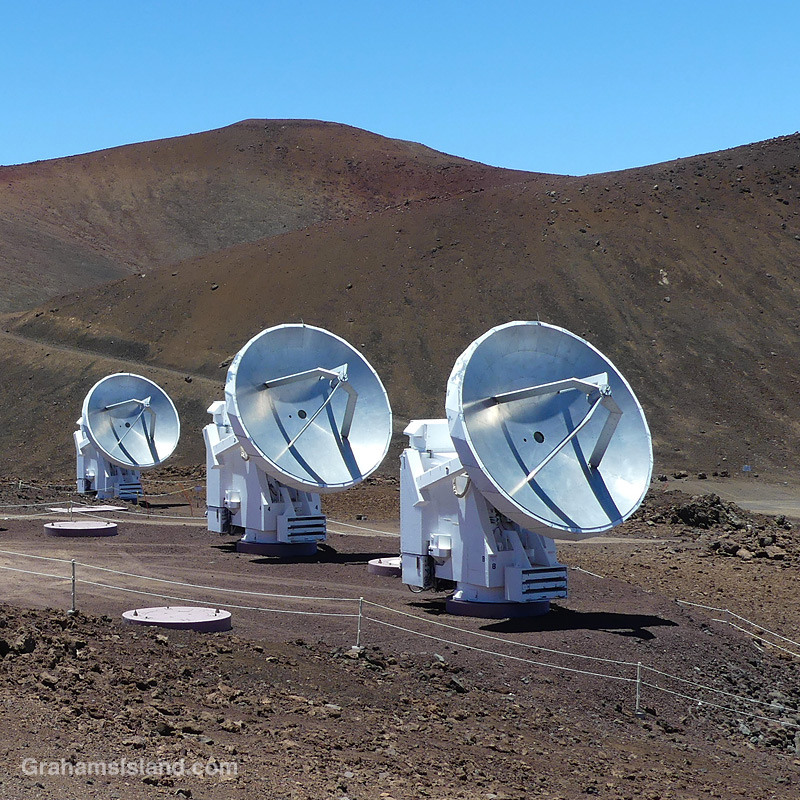
According to their website (here), the Smithsonian Submillimeter Array (SMA) on Mauna Kea “is a type of multiple-antenna observatory known as an interferometer, in this case consisting of eight radio dishes, each 6 meters in diameter. The eight antennas observe the same astronomical object simultaneously. Combining the light measured by all the dishes produces an interference pattern, which results in a sharper image than could be made by any of the individual antennas. For that reason, the eight-antenna interferometer behaves like a single telescope as much as 500 meters (one-third of a mile) across.”
These dishes sit on little concrete pads, which can also be seen in these photos. If a change in the dish configuration is needed, they can be moved from one pad to another. What I’ve always liked about this is that some of these pads are only a few feet apart. I like to imagine conversations along the lines of:
“We need more data from the Invisible Particle Cluster. Let’s move Dish Three over there.”
“You mean, to that pad six feet away. Why didn’t I think of that?”
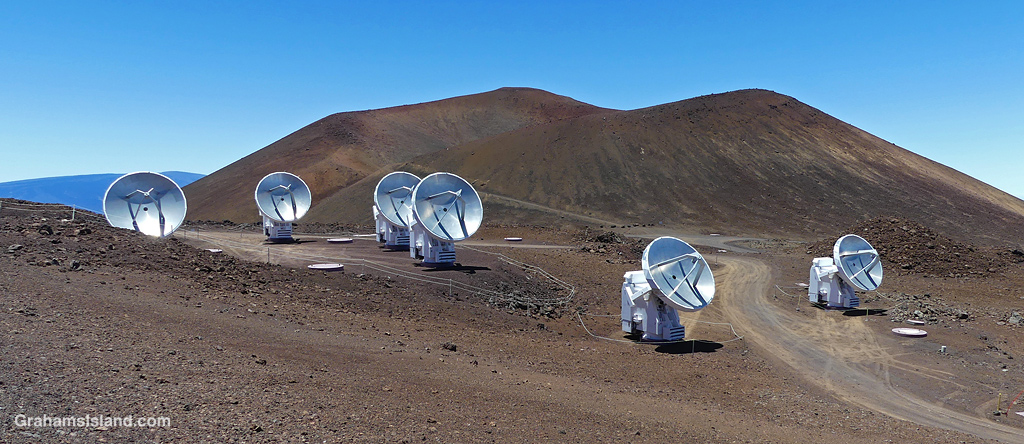
Of course, there are probably good scientific reasons for moving the dishes around like chess pieces. However, in chess one only has to lean forward, lift an itty-bitty piece of wood, and plunk it on a new square, while giving your opponent a knowing smirk. These dishes are big and heavy. Even Arnold Schwarzenegger, in his heyday, would have trouble moving one without the assistance of special effects.
That’s why they have the vehicle below. I suspect this is not something purchased at the local used car dealership. I suspect it costs a good deal more than the combined value of all the vehicles at the local used car dealership.
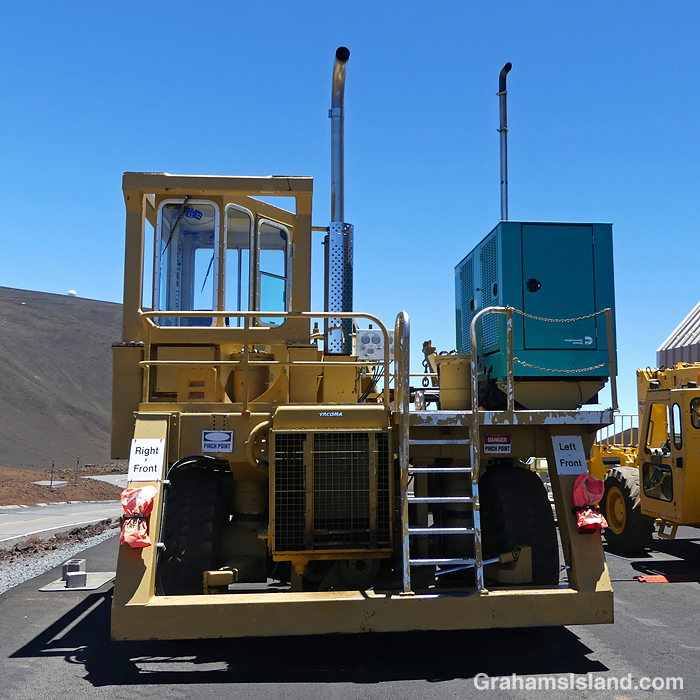
It’s something of an out-of-this-world design, which is entirely appropriate. There are two things I really like about this vehicle. One is that the scientific minds have thought it prudent to label the front and back, left and right of it. This way, everyone knows whether the vehicle is moving forwards, backwards, or sideways. The other is that they have also recognized that for safe, efficient operation, it’s important to have, in the cab, a pair of fuzzy dice.
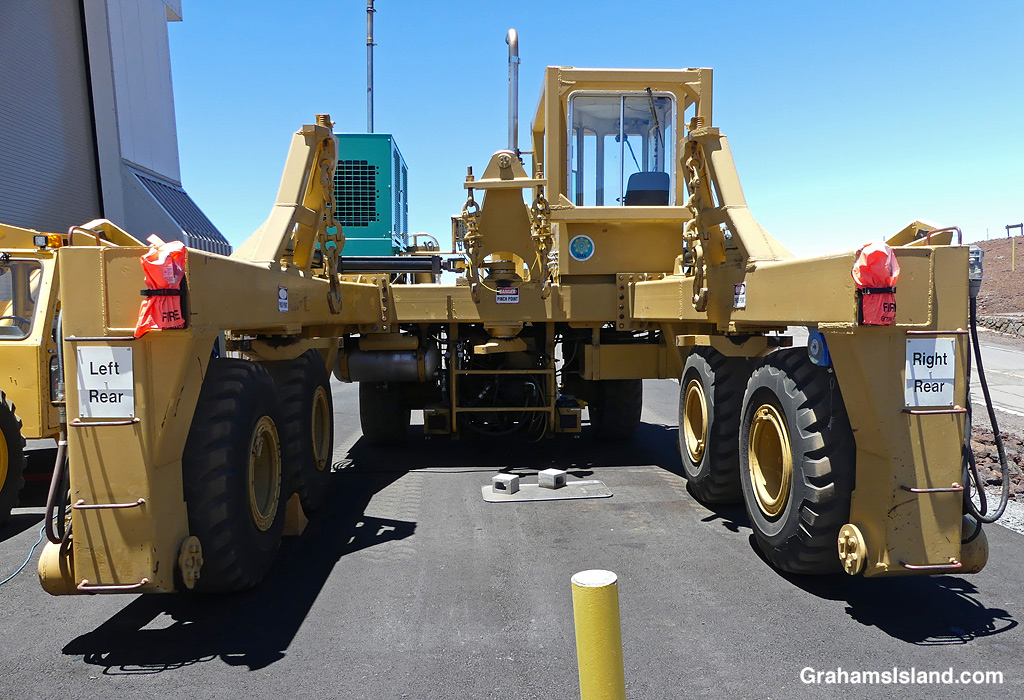
Posted for Becky’s Squares: Move Forward, Reconstruct, Renew, and/or are Burgeoning. See more responses here.

After the flash floods around Kawaihae, a couple of weeks ago, I noticed this area where sizable boulders had been washed up against the highway guard rail. A week later, the area had been cleaned up and the drainage channels reconstructed.

I thought the contrasting views were interesting, but what really caught my eye, was the land beyond the drainage channel. Dusty brown in the top photo, it turned a bright shade of green, thanks to the deluge of rain. The top photo is quite representative of the area around Kawaihae, which is the driest part of the island, but the bottom one is how most of it looks currently, at least for a short while.
Posted for Becky’s Squares: Move Forward, Reconstruct, Renew, and/or are Burgeoning. See more responses here.

I saw these cheerful cacti burgeoning in downtown Hawi recently.
Posted for Becky’s Squares: Move Forward, Reconstruct, Renew, and/or are Burgeoning. See more responses here.
 Graham's Island