Author Archives: Graham

Unknown's avatar

About Graham

I take photos when I'm out and about, recording life on the Big Island of Hawaii.

A new route up Pu’u Wa’a Wa’a

A view of PuuWaaWaa, Hawaii
Williwilli flowers at PuuWaaWaa, Hawaii

Pu’u Wa’a Wa’a is a cinder cone on the slopes of Hualalai volcano. The name means “many-furrowed hill,” and it’s a place I like to walk at least once a year, but it had been a while since I was up there. Usually, I go there in the spring when Jacarandas and other flowers are blooming. I also try to go in the early morning, since the area tends to cloud up during the day and the wonderful views become obscured.

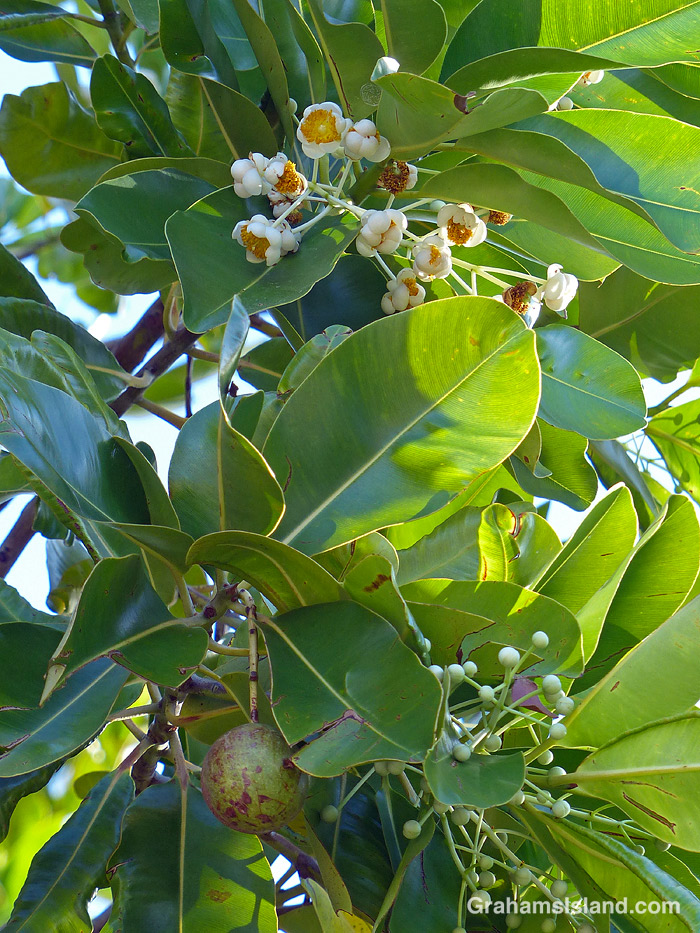
A couple of weeks ago I made a late decision to do the hike again since the weather looked unusually good. I got there around 2pm and it will come as no surprise that I spent the first 15 minutes of the hike taking photos of Williwilli flowers on a tree about 20 feet from where I parked! (More of those in a few days.)

Silk oak flowers at PuuWaaWaa, Hawaii

The trail follows an old road up the hill past Silk Oak trees, at the tail end of their flowering and sporting a deep red hue I hadn’t seen before. Turn around, and there are good views of Maui to be had. The old road peters out near an old blockhouse, now lacking doors and windows, which offers shelter to livestock on the ranch here. Off to one side is an old quarry, which cuts into the side of the hill. Usually there are goats in this area, but I didn’t see any on this day. Farther up is what’s left of Tamaki Corral, which dates back around 100 years.

Not far after the corral, the trail climbs steeply toward the top. This was where I found a change in the trail. Whereas before the trail was an out-and-back up a steep slope to the top, now a loop has been created. I took this new option to the top where, on this remarkably clear late afternoon, I had great views of Maui, Kohala Mountain, Mauna Kea, Mauna Loa, and Hualalai. A new sign at the top welcomes hikers to the nearly 4,000 foot summit, and there’s a survey marker at the top riddled with holes, not from gunfire, but to let the wind blow through. There are also a couple of benches where one can sit a while enjoying the views (weather permitting). The hike is steep in places, but not difficult, though not everyone makes it back alive!

I followed the old trail back down and ran into several sheep, which have the run of the land up here, as the sun dipped behind the ridge.

One other difference I noticed with this afternoon hike was the proliferation of birds. There were large numbers of finches, mostly Saffron Finches flitting about, preparing to roost for the evening. Yellow-fronted Canaries were all over the tree tobacco flowers. I also saw, and heard, several Erckel’s Francolins doing their usual fine job of blending in with the vegetation.

And as I walked back down the hill towards my car, the late afternoon sun still shone, illuminating grasses alongside the trail.

Grasses on PuuWaaWaa, Hawaii

Posted for Jo’s Monday Walk. See more walks here.

Recycling

Recycled glass in Hawaii

This week’s Sunday Stills challenge theme is ‘Glass.’ See more responses here.

We don’t have trash pick up here. Instead, we take our trash to the transfer station, which is also the place to take items for recycling. These days, only glass and corrugated cardboard are being recycled. In the past, they also took other cardboard, paper, cans, and plastics. But those things were dropped, supposedly because of a lack of a market for them. Another factor is that it’s been difficult keeping transfer stations staffed and open. Finding staff to deal with recycling is probably impossible right now.

Even with just glass and corrugated cardboard accepted, I see people, no doubt with good intentions, putting the wrong things in the wrong places. The idea is to recycle glass, not glass in a cardboard box or plastic bag or with the cap on or surrounded by insects because it hasn’t been rinsed out!

I read somewhere that one of the reasons some nations stopped accepting recycled materials is that too many shipments were not recyclable, but were essentially trash. Still, I continue to drop my glass in the recycling container in the hope that it does some good. Incidentally, these aren’t all my bottles and jars! These were in the recycling skip.

Stunned Zebra Dove

A zebra dove in Hawaii
Where am I? What am I? What’s going on!
A zebra dove in Hawaii
What’s that? Why does my head hurt?
A zebra dove in Hawaii
Is he the one that hit me?

This Zebra Dove recently cannoned into a window at work. Outside, we found it lying on the ground, out cold. At first, we thought it was dead, but then detected signs of life. So, having seven cats living around the place, we took it inside in the hope that it would recover.

It did soon start to look better and the first thing it did was take wing and cannon into a window from the inside. So we took it outside again and installed it on this branch. It gripped the branch and looked fairly secure, though its blank expression suggested it didn’t have much idea of how it had come to be there.

Gradually the dove recovered, looked around a bit, and gave me a disapproving stare. After a while, it flapped over to a different branch and took on the wide-eyed look that is more typical of these doves. In these circumstances though, that look could be interpreted in a raft of different ways.

Eventually, the dove flew off and I was glad to see that it safely negotiated the branches and trees surrounding it without banging into anything else.

A zebra dove in Hawaii
Oh my god, who are these people? I’ve got to get away from here.

EV Nautilus

The NOAA EV Nautilus off the coast of Hawaii

I saw this ship off the coast of North Kohala, but couldn’t immediately identify it because it was too far offshore. Luckily, it hung around and a couple of days later I saw it much closer and stopped to take photos.

The ship is the Nautilus and it’s an exploration vessel operated by the Ocean Exploration Trust and was engaged in research, sponsored by the National Geographic Society. They were studying marine mammal vocalization and local shark diversity and abundance around Hawaii.

For more information about the ship, go to https://oceanexplorer.noaa.gov/technology/vessels/nautilus/nautilus.html. For more information about the research project, go to https://nautiluslive.org/.

The NOAA EV Nautilus off the coast of Hawaii

Red Reef Lobster molt

A Red Reef Lobster molt in the waters off Hawaii

I saw this scene almost immediately after getting in the water, the bright red catching my eye. At first I thought it was some kind of garish fishing lure, snagged in the rocks. Then I saw other details and figured it must be some kind of marine invertebrate and probably a molt.

When I got home, checked the photos, and consulted my marine invertebrates book, I realized it was the molt of a Red Reef Lobster. Its sensory hairs can clearly be seen on the claw. These lobster are active at night and so rarely seen, but they can live in shallow waters and they molt every 6 weeks or so.

I doubt I’ll ever see a live Red Reef Lobster, so this is probably as close as it gets.